

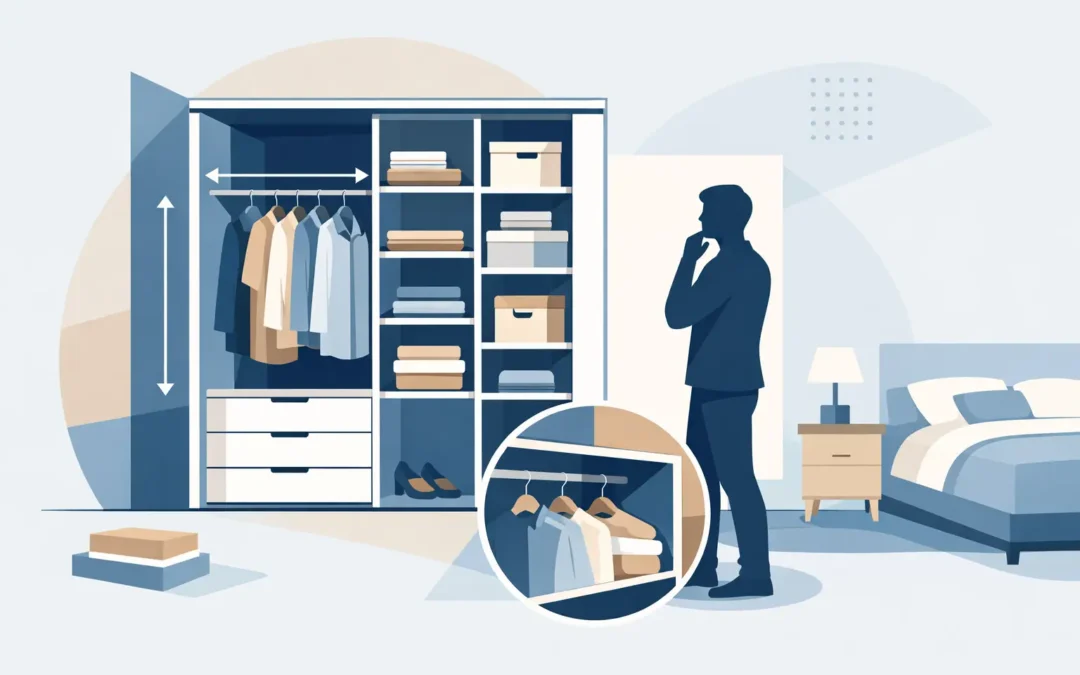
A wardrobe can look perfect on paper and still feel awkward the moment you use it. That usually comes down to depth. If you are asking what is the depth of fitted wardrobes, the short answer is that most are built at around 600mm deep – but the right depth depends on what you need to store, the style of doors, and how much space the room can comfortably give up.
This is one of the first dimensions worth getting right, because it affects far more than hanging space. It influences how easy the wardrobe is to use, whether clothes sit properly on the rail, how far doors project into the room, and whether the whole installation feels sleek or bulky.
What is the depth of fitted wardrobes in most homes?
For most fitted wardrobes, a total external depth of around 600mm is the standard starting point. That measurement usually allows enough room for hanging clothes without doors pressing against sleeves, jackets or coat fronts.
In practical terms, standard clothes hangers tend to need around 450mm to 500mm of internal space for garments to hang neatly. Once you add door thickness, back panels and a little clearance, 600mm becomes the sensible benchmark. It works well for shirts, dresses, jackets and most everyday clothing.
That said, fitted furniture should not be designed by rule of thumb alone. A wardrobe built for a main bedroom may need different proportions from one going into a box room, loft conversion or spare room. The best result comes from designing the depth around the room rather than forcing the room to accept a standard box.
Why wardrobe depth matters more than people expect
Depth is not just about whether a hanger fits. It affects the way the whole room functions.
If a wardrobe is too shallow, clothes can be crushed behind the doors or pushed out of line. Sliding systems may catch garments, and hinged doors may close against sleeves. On the other hand, if a wardrobe is made deeper than necessary, it can eat into valuable floor space and make a bedroom feel tighter than it needs to.
There is also the question of visibility. Very deep shelving often sounds useful, but in reality it can become dead space at the back where folded items disappear for months. Good fitted design is not about creating the biggest possible carcass. It is about creating storage that is easy to access and pleasant to use every day.
Standard depth vs bespoke depth
Off-the-shelf wardrobes usually force you into a fixed size. Fitted wardrobes should do the opposite. A bespoke design gives you the chance to adjust depth according to the room layout, ceiling line, chimney breast, alcoves or awkward corners.
A 600mm depth is still the most common choice because it suits most hanging storage. But there are plenty of situations where a bespoke solution improves the result. In a narrow bedroom, trimming the depth slightly may make circulation much better. In a dressing area or larger principal bedroom, a deeper unit might be worth considering if you want chunkier doors, extra internal features or a more substantial built-in look.
This is where experienced design matters. The goal is to protect the storage function without compromising the room itself.
When a shallower fitted wardrobe can work
Not every room has the luxury of a full-depth wardrobe. Smaller bedrooms, converted spaces and rooms with limited walkway clearance often need a more compact approach.
Shallower wardrobes can work, but only if the internal layout is designed properly. If the depth drops below the usual 550mm to 600mm range, a standard hanging rail may no longer be the best option. In those cases, pull-out rails or front-facing hanging arrangements can be a smarter use of space.
This is often useful in children’s bedrooms, guest rooms or hall storage where bulky clothing is not the main priority. Shelving, drawers and compartmentalised storage can also make a shallow wardrobe far more effective than people expect. The trade-off is simple: you gain floor space, but you may lose some hanging practicality.
That trade-off can still be well worth making if the room feels better balanced overall.
When going deeper makes sense
A deeper fitted wardrobe is not always better, but there are cases where it earns its keep.
If you want to store heavier winter coats, suit carriers, longer garments or integrated laundry sections, extra depth can help. It can also be useful when incorporating internal drawers behind doors, wardrobe lighting, or more decorative door fronts where thicker framing slightly reduces usable internal space.
In larger bedrooms, increasing the depth can create a more premium fitted look, especially when paired with floor-to-ceiling designs. The key is not to create depth for its own sake. Beyond a certain point, deep wardrobes can become less practical unless the inside is carefully planned.
A common mistake is assuming that more depth automatically means more storage. In reality, badly organised deep storage often wastes space rather than improving it.
Door style changes the depth you need
One of the most overlooked parts of the question what is the depth of fitted wardrobes is the door style. Hinged and sliding doors behave differently, and that has a direct impact on the final design.
Hinged doors usually allow easier access to the full interior and can work well with a standard 600mm depth. They need clearance in front when open, so they suit rooms where there is enough space to move comfortably.
Sliding wardrobes are useful where floor space is tighter, because the doors do not swing out into the room. However, sliding door systems often require their own track allowance, which can reduce internal depth. That means the wardrobe may need to be slightly deeper overall to preserve usable hanging space inside.
This is one of the reasons fitted wardrobes should always be planned as a complete system, not just as a row of cabinets with doors attached later.
Internal layout matters just as much as external depth
Two wardrobes can both be 600mm deep and perform completely differently. The inside is what makes the difference.
A wardrobe designed mainly for long hanging will need different spacing from one built around double hanging, shelves and drawers. Shoe storage, pull-out baskets, jewellery trays and overhead compartments all influence how useful that depth feels in real life.
This is where a made-to-measure approach pays off. Rather than asking only how deep the wardrobe should be, it is better to ask what the wardrobe needs to do. Once that is clear, the right depth follows much more naturally.
For example, if you have a large collection of folded knitwear, shelving may matter more than maximum hanging depth. If you wear suits or long coats regularly, preserving enough internal clearance becomes more important. Good design always starts with usage.
Room size and proportions should lead the decision
In fitted bedrooms, there is always a balance between storage volume and visual space. A wardrobe that projects too far can make the bed feel boxed in. One that is too slim may look neat but fail to do the job.
That is why measurements should be judged in context. A generous principal bedroom can usually take a full-depth wardrobe with ease. A compact spare room may need a slightly reduced depth to keep the room comfortable. In loft rooms, sloping ceilings and knee walls may call for a combination of full-depth and reduced-depth sections.
The smartest fitted schemes work with the architecture rather than fighting it. They make the room feel intentional, not overfilled.
The best answer is usually a measured one
If you want a simple rule, 600mm is the standard answer to what is the depth of fitted wardrobes. It is a reliable starting point and suits most homes well. But the best depth is the one that fits your room, your clothes and the way you live.
That is why proper measuring and design advice matter. A bespoke wardrobe should not just fill a wall. It should improve the way the room works, look balanced from every angle and give you storage that feels easy from day one.
At WOW Interior Design, this is exactly why fitted furniture is measured and planned around the home rather than pulled from a catalogue. The right depth is rarely guesswork. It comes from understanding the room properly and designing storage that earns its place.
If you are planning fitted wardrobes, think beyond the headline measurement. The best wardrobe depth is the one that makes the room feel calmer, more organised and easier to live in every single day.