

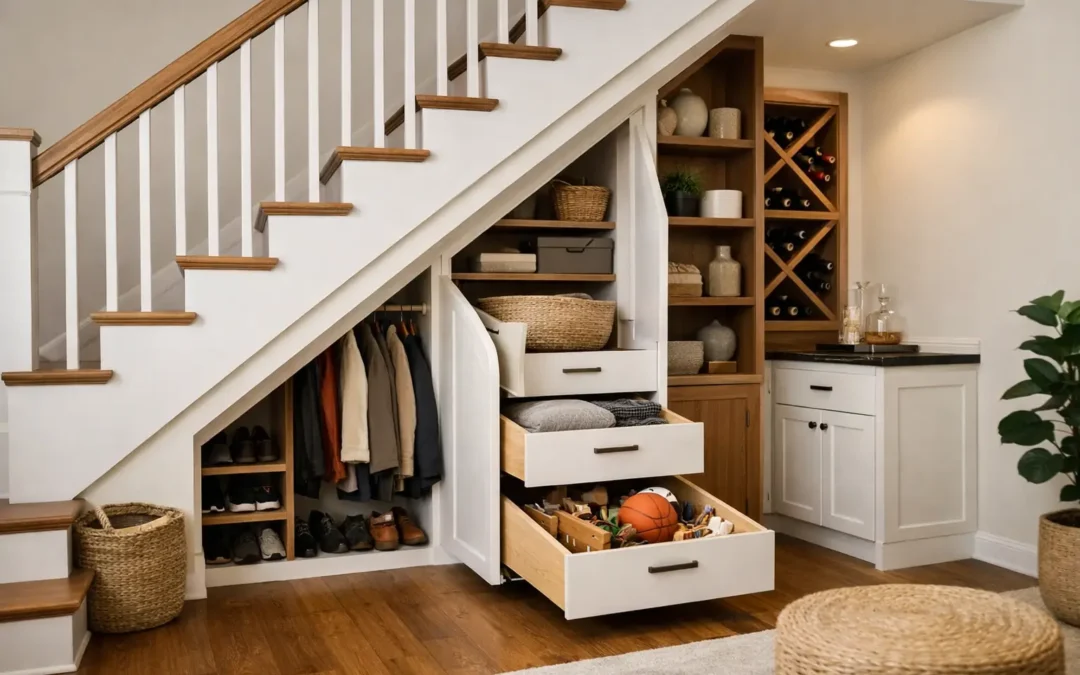
The area beneath a staircase often becomes a holding bay for coats, shoes, bags and things that have nowhere else to go. A well-planned under stairs storage ideas guide changes that completely, turning an awkward wedge of space into a useful, good-looking part of the home rather than a permanent source of clutter.
The best answer is rarely a standard cabinet pushed against the wall. Every staircase has its own pitch, depth, access point and relationship with the hallway or living room around it. Bespoke fitted storage makes the most of those details, creating a finish that looks designed for the house because it is.
An under stairs storage ideas guide for your layout
Before choosing drawers, cupboards or shelves, consider how the space needs to work day to day. A busy family hallway needs a different solution from a staircase opening into a lounge. The first question is not what will fit underneath the stairs. It is what regularly causes frustration elsewhere in the home.
Shoes piling up by the front door, coats thrown over the bannister and school bags left on the floor all point towards practical hallway storage. In a living area, the same space may be better used for books, media equipment, occasional furniture or a discreet home bar. If the staircase is close to the kitchen, it can even provide valuable pantry-style storage for dry goods and larger appliances.
A professional measure is particularly worthwhile here. The visible triangular opening does not always show the full usable depth behind it, and structural features, pipework, electrical points and the staircase construction must all be considered before a design is agreed.
Choose storage that suits how you live
Pull-out drawers for shoes and everyday essentials
Full-depth pull-out drawers are one of the most effective under stairs options, particularly in a hallway. They bring the contents forward, so nothing gets lost in a dark cupboard at the back. Deep lower drawers can hold shoes, boots, umbrellas and sports kit, while shallower drawers are useful for scarves, dog leads, hats and household essentials.
Drawers give a clean exterior and keep visual clutter behind matching fronts. They are a strong choice where there is enough width along the staircase, although very narrow or sharply sloping spaces may be better suited to a cupboard with internal shelving. Soft-close runners are worth including in a family home, where the storage will be used repeatedly every day.
A fitted coat cupboard
Where the staircase has enough height at one end, a tall cupboard can replace the need for a freestanding coat rack. A hanging rail, hooks and a shelf above create a proper home for outerwear, freeing up the entrance and making the first impression of the house far calmer.
This option works best when the cupboard is designed around the coats you actually own. Long winter coats need more hanging height than children’s jackets, while a dedicated lower shelf or ventilated section for shoes keeps damp footwear away from clean clothing. For some households, a combination of one tall hanging cupboard and adjoining drawers is more useful than trying to make every section identical.
Shelving and display storage
Open shelving can make an under stairs area feel lighter, especially in a living room or a wide entrance hall. It offers a natural place for books, ceramics, framed photographs and carefully chosen baskets. With integrated lighting, the space can become a feature rather than simply a concealed storage zone.
There is a trade-off. Open shelves ask you to keep their contents tidy, and they are less suitable for the everyday clutter of family life. A balanced design often combines open display sections at eye level with closed cupboards below, giving the room personality without putting every practical item on show.
A compact home office
For homeowners short on a separate study, the space under a staircase can make an excellent compact workstation. A fitted desk, drawers, shelves and discreet cable management can create a productive place for household admin, occasional remote working or children’s homework.
This approach depends on available headroom and natural light. It is more comfortable where the staircase is open to a larger room rather than enclosed in a narrow hallway. Task lighting and a sensible desk depth matter just as much as the cabinetry. A beautiful desk that is too shallow for a laptop and paperwork will not earn its keep.
Utility, pantry or pet storage
Some under stairs spaces solve very practical problems. Tall shelves can hold cleaning products, the vacuum, ironing board and laundry supplies. Near a kitchen, fitted pull-outs may organise tins, bottles and pantry goods. A lower cupboard can also be designed as a tidy sleeping space for a dog, with ventilation and an opening that feels part of the furniture rather than an afterthought.
For utility use, moisture and access need careful thought. Cleaning equipment should be easy to retrieve, and pipes or stopcocks must remain accessible. Bespoke design allows for these requirements instead of concealing them behind a fixed unit that becomes difficult to maintain.
Make the finish feel part of the house
The storage may be highly practical, but it remains a prominent part of the interior. Door style, handles, colour and detailing should relate to the hallway, staircase and nearby rooms. A contemporary home may suit flat-panel doors with discreet handles, while a more traditional property can carry shaker-style fronts, painted finishes and considered mouldings beautifully.
Painted cabinetry is especially useful beneath stairs because it can match or complement existing wall colours, panelling and joinery. A soft neutral can help a dark hall feel more open, while a deeper colour gives the storage a confident, furniture-like presence. If the area is visible from the lounge, matching it to existing fitted furniture can make the layout feel far more intentional.
Lighting also deserves attention. Internal cupboard lights make deep storage genuinely usable, while warm LED lighting in an open niche adds atmosphere. The goal is not to over-light a small space, but to ensure it works well on a dark winter morning and still looks considered in the evening.
Details that prevent expensive mistakes
Good under stairs storage starts with accurate dimensions, but the details are what determine whether it remains useful. Doors need room to open without blocking a route through the hall. Drawers need enough clearance to extend fully. Skirting boards, stair strings, radiators and nearby sockets should be incorporated rather than treated as awkward surprises during installation.
It is also wise to plan for the less glamorous items. Where will the router live? Does the vacuum need a charging point? Will pushchairs, folding chairs or Christmas decorations need to fit? The answers influence internal shelf heights, drawer depths and cable access. A bespoke unit should accommodate real life, not just look impressive on fitting day.
For period homes in Kent and across the South of England, walls and floors are not always perfectly level. That is another reason fitted furniture has an advantage over off-the-shelf units. The cabinetry can be made and installed to follow the character of the property, with neat scribing and finishing that avoids unsightly gaps.
When bespoke storage is the better investment
Freestanding furniture may be enough if you need a quick, low-cost place for a few pairs of shoes. But it leaves unused space around and above the unit, and it often struggles with the angle beneath the stairs. Bespoke storage becomes the stronger choice when the space is prominent, heavily used or unusually shaped.
At WOW Interior Design, the process begins with understanding how the household uses the area, followed by an in-home measure and a design built around the available space. That means the interior layout, door style, finish and practical fittings can be decided before installation, rather than relying on compromise once the furniture arrives.
The right under stairs solution should make daily routines easier and make the home feel more settled. Start with the clutter you want to remove, then let the shape of the staircase guide a design that gives every inch a proper purpose.