

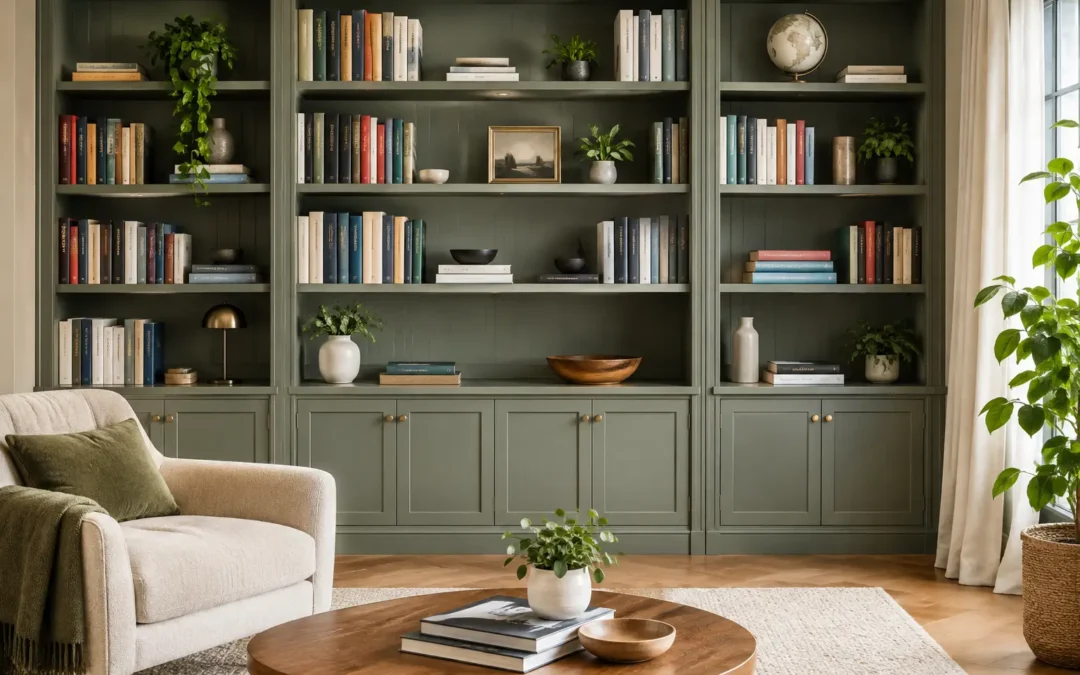
A built-in library should make a room feel calmer the moment you walk in, not become a handsome place to hide piles of books, cables and forgotten paperwork. Knowing how to organise a built-in library starts with treating it as part of the room’s working design, rather than simply filling every shelf from end to end.
The best arrangements balance the books you genuinely use with the objects that make a home personal. A well-planned fitted library can hold a sizeable collection, create a focal point and provide discreet storage for the less attractive essentials of daily life. The key is deciding what each part of the furniture needs to do before you start styling it.
Start by deciding what your library is for
Not every built-in library needs to be organised in the same way. A library in a formal sitting room may mainly display books, art and collected objects. One in a family room might need to accommodate children’s books, board games, technology and practical storage. A library surrounding a home office may need space for reference books, files and equipment as well as a more polished backdrop for video calls.
Begin by taking everything off the shelves. It may feel disruptive, but it is the quickest way to see what you own and what is taking up valuable space. Separate books you read regularly from those you keep for sentimental reasons, books you intend to pass on and books that have simply stayed put out of habit.
Do the same with decorative items. Keep the pieces that add real character, but avoid using ornaments to fill every spare gap. A fitted library has a stronger presence when some shelves have room to breathe.
Create clear shelf zones before arranging books
A built-in library looks intentional when it has a simple structure. Think in zones rather than trying to make every shelf do everything. Keep frequently used books between waist and eye level, where they are comfortable to reach. Reserve higher shelves for less-used hardbacks, special editions or display pieces, and use the lowest areas for heavier books, children’s titles or closed storage.
Where the cabinetry includes cupboards or drawers, use them properly. These are ideal for items that do not contribute to the room’s appearance: paperwork, chargers, games, printer supplies, remote controls or spare stationery. This is where bespoke furniture has a real advantage. A library can be designed around the way you live, with deep base cupboards for larger items, shallow drawers for smaller essentials and adjustable shelves where book heights vary.
If you are planning a new fitted library, it is worth considering the collection before finalising the design. Large art books, records, folders and magazines all need different depths and heights. Standard freestanding bookcases often force compromises. Tailored shelving lets the library look considered while still accommodating the things you actually want to keep.
Allow for visual breathing room
It is tempting to pack shelves tightly, particularly if you have a growing book collection. Yet leaving a small amount of space on each shelf makes it easier to remove a book without disturbing the whole row. It also prevents the library from looking heavy and overcrowded.
Aim to leave a few shelves partly open for a framed photograph, a ceramic piece or a low bowl. These details work best when they are chosen with restraint. A few larger, meaningful objects will look more confident than lots of small decorative items spread across every level.
Choose a sorting system you will maintain
There is no single correct way to arrange books. The right method depends on whether you want to find titles quickly, create a visual statement or do a little of both.
Alphabetical order is practical for large collections and works particularly well for fiction, reference titles or books shared by several people in the household. You can arrange by author surname, then group genres together if that makes browsing easier. For a collection based around interests such as travel, gardening, history or cookery, organising by subject is often more useful.
Colour-coordinated books create an attractive display, but they can make individual titles harder to locate. It is a good choice for a smaller, curated collection or for shelves intended mainly as a design feature. A middle ground often works best: organise the books you use by category or author, then use colour and scale to create balance within each section.
Try arranging some books vertically and a small number horizontally. Horizontal stacks can break up a long run of spines and create a resting place for a decorative object, but too many will make shelves look untidy. Use this approach sparingly, especially in a more traditional room.
Organise a built-in library around everyday life
A beautiful library that does not suit your routine will not stay organised for long. Put the books you reach for most often in the most accessible positions. Cookbooks belong near the kitchen or dining space if that is where they are used. Family albums may be better stored safely behind cupboard doors, ready to bring out rather than left exposed to sunlight and dust.
For homes with young children, give them a clearly defined lower section. Forward-facing picture books are easier for smaller children to choose and put away, while baskets or low cupboards can hold toys that would otherwise migrate across the room. As children grow, that same zone can become space for novels, schoolbooks or games.
A library wall with a television needs particular care. Avoid letting the screen dictate the whole display. Position books and accessories to create an even frame around it, while using lower cupboards to conceal consoles, cables and media equipment. Ventilation should always be allowed for electronics, so this is a detail best considered during the design stage rather than solved afterwards.
Keep paperwork out of open shelving
Paper is one of the quickest ways to spoil the look of a library. Open shelves are not the right home for loose documents, instruction manuals or unopened post. If your library also supports a workspace, use labelled files, drawers or enclosed cabinets for administration.
The labels do not need to be on show. Their job is to help the household return things to the right place. When every item has a home, keeping the room orderly takes minutes rather than becoming a weekend task.
Use proportion, not symmetry, to style the shelves
Perfect symmetry can look stiff, especially across a large wall of fitted furniture. Instead, aim for visual balance. If one side has a tall vase or a group of substantial books, offset it elsewhere with a similarly weighted arrangement. Repeat a material or colour two or three times across the library – perhaps brass, natural wood, black frames or a colour taken from the room’s soft furnishings.
Pay attention to scale. Tiny objects can disappear against a tall library, while overly large pieces can make the shelving look cramped. Larger accessories tend to work best on wider shelves, with smaller pieces used only where there is enough clear space around them.
Lighting can transform the finished result. Integrated LED lighting brings depth to darker shelves, highlights favourite pieces and makes the library feel welcoming in the evening. Warm lighting usually suits living spaces better than a harsh white tone. It should support the joinery and the room, rather than becoming the main event.
Plan for growth and seasonal changes
Even a carefully organised library changes over time. New books arrive, children’s interests shift and display pieces move around the home. Build in a little spare capacity from the beginning, rather than filling every shelf to its limit.
A quick reset two or three times a year is usually enough. Dust the shelves, remove anything that no longer belongs there, straighten book rows and reassess any accessories that have lost their place. This is also a good opportunity to move books away from direct sunlight, which can fade spines and damage covers over time.
For a truly tailored result, the cabinetry itself should support organisation. Adjustable shelving, thoughtfully sized cupboards, integrated lighting and a finish that works with the wider room all make a difference. At WOW Interior Design, we design fitted libraries around the books, belongings and practical needs of the people using them, rather than asking homeowners to adapt to a standard unit.
The most successful built-in libraries do not look overly styled or precious. They feel lived in, easy to use and quietly ordered – a place where favourite books are always within reach and everyday clutter has somewhere else to go.