

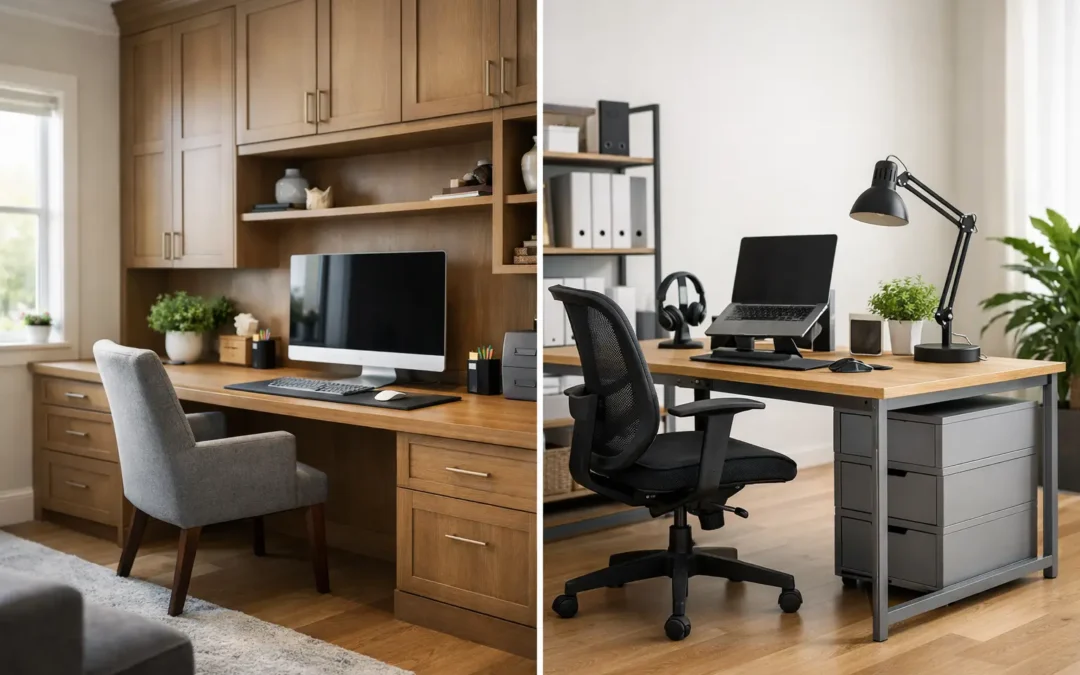
The wrong home office setup usually shows itself within a week. Cables start creeping across the floor, paperwork lands on any spare surface, and the desk that looked fine online suddenly feels too shallow, too bulky or simply out of place. When weighing up home office cabinetry vs modular desks, the real question is not which one looks better in a photo. It is which one will work harder for the way you live, work and use your space.
For some households, a modular desk is a sensible, fast solution. For others, fitted cabinetry turns an awkward spare room, alcove or landing into a properly organised workspace that feels like part of the home rather than a temporary add-on. Both options have their place. The best choice depends on how permanent your setup needs to be, how much storage you need, and whether you want to make the room work around the furniture or the furniture work around the room.
Home office cabinetry vs modular desks: what is the real difference?
A modular desk is usually made up of freestanding components. You buy a desk, perhaps a pedestal, a shelf unit or a matching cupboard, then arrange them to suit the room. It is flexible, often quicker to source, and can be moved if you change house or switch rooms.
Home office cabinetry is different in both purpose and result. It is designed around the room itself, with cabinetry, shelving, worktops and storage built to exact measurements. Instead of filling a space with separate items, fitted furniture uses the full width, height and depth available, including awkward corners, sloping ceilings and alcoves.
That difference matters because a home office is rarely just a desk. It often needs to store files, printers, chargers, stationery, household paperwork and the clutter that comes with day-to-day life. Once those items are factored in, the question becomes less about the desk and more about the whole room.
When modular desks make sense
Modular desks are often the right answer if you need speed, flexibility or a lower upfront spend. If your work setup is still evolving, or if the room serves several purposes, freestanding furniture can be practical. You can start with the basics, add pieces over time and reconfigure the layout if your needs change.
That can work well for occasional home working, student study areas or multi-use guest rooms where a permanent fitted scheme would be more than you need. If you are renting, planning a move, or simply want a stopgap while you decide on a longer-term layout, modular furniture keeps your options open.
There is also a style argument in its favour. Some homeowners prefer a lighter, less built-in look, especially in period homes where they do not want fitted furniture to dominate the room. A well-chosen modular desk can feel clean and understated.
The trade-off is that modular systems nearly always leave space unused. Gaps above units, dead corners and awkward edges are common. Those gaps collect clutter quickly. Freestanding pieces can also look pieced together rather than integrated, particularly if the room has unusual proportions.
Where fitted home office cabinetry earns its place
If the goal is to create a polished, long-term workspace that feels considered and organised, cabinetry usually wins. It does more than provide a desk surface. It gives every item a place, hides what you do not want on show and makes the room feel calmer because the visual noise is reduced.
This is especially valuable in homes where the office needs to look presentable outside working hours. A fitted setup can include closed cupboards, open shelving, integrated drawers and concealed cable routes so the room still feels smart in the evening or when guests visit. That matters more than people expect, particularly when the office is part of a bedroom, reception room or open-plan area.
Cabinetry also solves proportion problems. In many British homes, spare rooms are narrow, alcoves are uneven and box rooms need every inch used properly. Standard desks are made to standard sizes. Rooms are not. Bespoke cabinetry bridges that gap by being designed around exact dimensions, not average ones.
For households with two people working from home, fitted designs are often the cleaner answer. A shared run of cabinetry with two workstations can look balanced and intentional, whereas trying to fit two separate modular desks into one room often feels cramped.
Storage changes the decision more than price does
People often begin this comparison by looking at cost, but storage is usually the factor that decides it. If all you need is a laptop surface and one drawer, modular furniture may be enough. If you need room for files, tech, supplies, books and daily household admin, that is a different brief entirely.
A modular desk with extra storage can seem cheaper at first. Then the add-ons begin. A filing cabinet here, a shelf there, perhaps another cupboard later. Before long, the room is full of separate pieces, and the total cost is higher than expected without delivering the same result.
Fitted cabinetry tends to cost more upfront, but it often replaces several items at once. More importantly, it uses the vertical space that freestanding furniture rarely handles well. Full-height storage, overhead cupboards and fitted shelving can transform a room that otherwise feels crowded.
That is why a proper design conversation matters. The right question is not, “How much is a desk?” It is, “What does this room need to store, and how do we want it to feel when work is finished?”
Style, finish and the look of the room
A home office should work hard, but it should also sit comfortably within the rest of the house. This is where cabinetry has a clear advantage. Because finishes, colours and proportions can be tailored, fitted furniture can match the character of the property and the taste of the homeowner rather than forcing the room to adapt to shop-bought pieces.
That could mean a painted finish in a specific colour, shaker-style doors for a softer look, or a more contemporary design with clean lines and handleless units. The point is control. You are not choosing the nearest available option. You are choosing what suits the room.
Modular desks offer less freedom here. Even well-designed ranges are limited by standard finishes and fixed dimensions. You may find something close to what you want, but close is not always enough when you are investing in a room you use every day.
In homes where interior cohesion matters, fitted cabinetry tends to feel more settled and more premium. It looks like part of the property rather than furniture that may be replaced in a few years.
Flexibility versus permanence
This is where the answer genuinely depends on your plans. Modular desks are more flexible in the literal sense. You can move them, swap them out and take them with you. If your work pattern is temporary or your home is likely to change soon, that flexibility has real value.
Cabinetry is a longer-term choice. It is designed to stay put and to serve the room properly over time. For many homeowners, that is the point. They are not looking for furniture they can shuffle around. They want a settled solution that removes compromise and makes the room easier to live with.
There is another kind of flexibility, though, and fitted design often performs better here than people assume. Bespoke cabinetry can be planned for mixed use, with a desk area that also supports hobbies, study, household admin or occasional guest use. Drawers can be configured around equipment you already own. Shelving can be sized for books, baskets or display. In other words, it may be permanent, but it does not have to be rigid.
Which option adds more value?
If by value you mean the cheapest route to a working desk, modular will usually come out ahead. If by value you mean better use of space, improved appearance and a room that feels genuinely finished, cabinetry often offers more.
Well-designed fitted furniture can also support the wider value of the home because it improves how the room functions and presents. Buyers and homeowners alike notice when a box room has been turned into an efficient office with proper storage rather than left as an afterthought. It makes the space easier to understand and easier to use.
That said, fitted cabinetry only adds value when it is designed well and installed properly. Poor layouts, shallow storage or clumsy proportions can make a room feel heavier, not better. This is why experience matters. A tailored design should solve problems, not build them in.
For homeowners who want a long-lasting, high-quality result, a bespoke approach is often the smarter investment. Companies such as WOW Interior Design build around the exact space, the storage needed and the finish required, which tends to produce a far stronger result than trying to assemble the answer from retail units.
How to choose between home office cabinetry vs modular desks
Start with honesty. How often do you work from home? How much needs to be stored? Does the room need to look smart when the laptop is closed? Are there awkward walls, alcoves or sloping ceilings that standard furniture will struggle with?
If your needs are simple, short term or likely to change, a modular desk may be all you need. There is no sense overbuilding a room that only has a light role in daily life.
If, however, the office is used regularly, visible clutter frustrates you, or the room has to work hard and look good, fitted cabinetry is usually the better answer. It gives you more control, more storage and a result that feels intentional from day one.
The right workspace should make life easier, not ask you to work around its limitations. When the furniture is designed to suit the room and the way you use it, the whole house tends to feel more organised.