

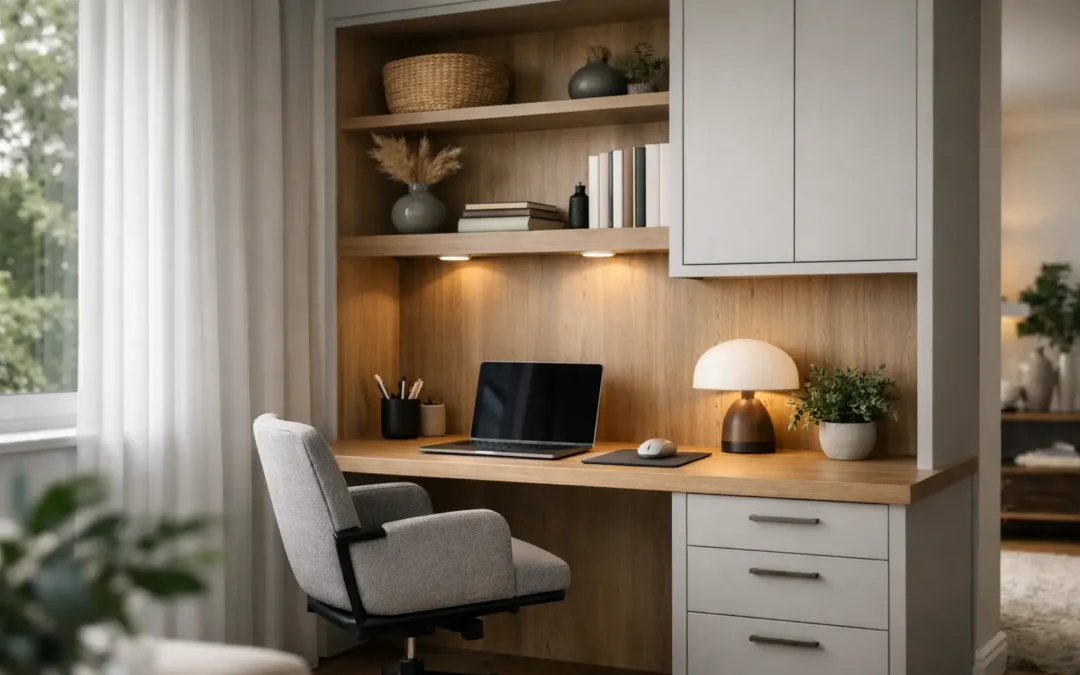
A spare bedroom with a desk pushed against the wall rarely stays tidy for long. Cables spread, paperwork piles up, printers migrate onto the floor and before you know it, the room is doing three jobs badly instead of one job well. That is usually the point when a built in home office Kent homeowners can rely on starts to make real sense – not as a luxury, but as a practical upgrade that gives the room purpose.
The biggest difference between fitted and freestanding office furniture is not just appearance. It is the way the whole room begins to work harder. A bespoke layout can follow the exact width of an alcove, wrap neatly around a chimney breast, run wall to wall under a window or turn an awkward box room into a fully functioning workspace. Instead of making do with standard sizes, the furniture is designed around how you actually live and work.
Why a built in home office in Kent makes more sense than off-the-shelf furniture
Most retail office furniture is built to average room sizes and average needs. Homes are rarely average. Period properties have uneven walls, newer homes often have compact bedrooms, and many families want a room that can switch between office, guest space and general storage without looking cramped.
That is where bespoke fitted furniture earns its keep. The desk height can be set to suit the user, shelving can be balanced with closed cupboards, and every inch of wall space can be used properly. You are not left with dead gaps above cabinets or wasted corners that gather dust. The result is cleaner visually, but it is also easier to use every day.
There is also the question of longevity. Freestanding desks and flat-pack storage often solve an immediate problem, but they rarely give a room a finished feel. A fitted home office is built as part of the room, so it tends to feel more considered and more valuable. For homeowners making long-term improvements, that matters.
What makes a good built in home office Kent project?
A successful home office starts with honest planning. Not every client needs a full wall of shelving, and not every room should be filled from floor to ceiling. The right answer depends on how the space is used and what needs to be stored out of sight.
For some people, the priority is a large desktop with room for dual screens, paperwork and charging points. For others, it is about hiding the mess – printers, files, routers and household admin tucked neatly behind doors so the room still feels calm at the end of the day. In family homes, the best designs often do both.
Good fitted design also takes the room itself seriously. Natural light matters. So does circulation space. If the desk is too deep, the room can feel pinched. If the shelving is too heavy visually, a small room quickly feels closed in. This is where bespoke work has a clear advantage. Proportions can be adjusted to suit the architecture instead of forcing the room to adapt to the furniture.
Storage that earns its place
The strongest home office designs are not packed with features for the sake of it. Every cupboard, shelf and drawer should solve a specific problem. Deep lower cupboards can hide bulky equipment. Slim upper shelving can keep books and decorative pieces within reach without dominating the room. Drawers can be sized for stationery, tech or paperwork rather than treated as a standard add-on.
That tailored approach keeps the room useful long after the initial excitement of a renovation wears off. A tidy office is easier to maintain when there is a clear place for everything.
A finish that feels part of the home
One of the main reasons homeowners choose fitted furniture is to make a workspace feel integrated rather than temporary. Painted finishes, carefully chosen handles, panel details and coordinated shelving all help the office sit comfortably with the rest of the house.
That does not mean every office needs to be traditional. Some look best with crisp, handleless lines and a clean contemporary finish. Others suit classic shaker styling or a softer painted look that works with an older property. The key is making the room feel deliberate. A home office should support productivity without looking like commercial furniture has been dropped into a domestic setting.
The rooms that benefit most from a built-in office
The obvious setting is the spare bedroom, but that is far from the only option. Box rooms are often ideal because fitted furniture can turn a narrow footprint into an efficient workspace. Underused landings, wide hallways and alcoves can also work surprisingly well if they are designed properly.
Garden-facing rooms are often popular because they offer better light and a calmer outlook. But even darker corners can be transformed with the right joinery, colour palette and integrated lighting. It depends less on the size of the room and more on how intelligently the layout is planned.
In some homes, the office needs to share space with a dressing room, library or guest bedroom. This is where bespoke design becomes especially useful. A single fitted scheme can combine a desk, wardrobes, cupboards and display shelving in one cohesive run, so the room remains balanced instead of looking like several unrelated pieces have been squeezed together.
Design decisions that affect daily use
A fitted office should look good, but the day-to-day details are what make it successful. Cable management is a simple example. If wires are left trailing behind a desk, the room never feels finished. Built-in solutions can allow for hidden routing, better socket positioning and sensible access points.
Lighting is another detail that is often underestimated. If a desk sits beneath shelving, task lighting may be needed. If the room is used in the evening, ambient lighting can stop it feeling stark and functional. The best schemes think about how the space will be used from morning through to late afternoon, not just how it looks in a photograph.
Then there is storage balance. Too much open shelving can become visual clutter. Too many solid doors can make a room feel heavy. Most well-designed offices benefit from a mix of both – practical hidden storage where needed, with enough open display space to keep the room personal and relaxed.
Why the process matters as much as the design
A fitted office is only as good as the measuring, planning and installation behind it. That is why homeowners often prefer a fully managed service rather than trying to piece together designers, suppliers and fitters separately. When one experienced team handles the survey, design development, manufacture and fitting, there is less room for compromise.
This matters particularly in older homes where walls may be uneven or angles less than straightforward. Bespoke fitted furniture should deal with those realities cleanly. A professional installation also affects the final finish more than many people expect. Sharp lines, neat scribing and respectful workmanship are what turn a good design into a room that feels properly complete.
For clients in Kent, that local knowledge can be useful too. Different property types bring different design challenges, from compact new-build rooms to character homes with alcoves, chimney breasts and unusual proportions. An experienced fitted furniture specialist will have seen those issues before and know how to make them work in the design rather than fight against them.
Built in home office Kent homeowners should consider as an investment
A home office is now part of how many households function, whether that means full-time remote work, hybrid working, running a business from home or simply managing family admin in one organised place. When the space works well, it reduces friction every day. That benefit is hard to measure on paper, but easy to feel once the room is in use.
There is also a wider value in making a home feel more ordered and more finished. Bespoke fitted interiors tend to lift a room because they remove the improvised look that freestanding furniture often creates. The office feels built for the home rather than borrowed from somewhere else.
At WOW Interior Design, that is exactly the point of fitted furniture – to make your dream room a reality through practical design, strong materials and installation that is handled properly from start to finish.
The best home office is not the one with the most shelves or the largest desk. It is the one that fits your room, your routine and the way you want your home to feel when the working day is done.