

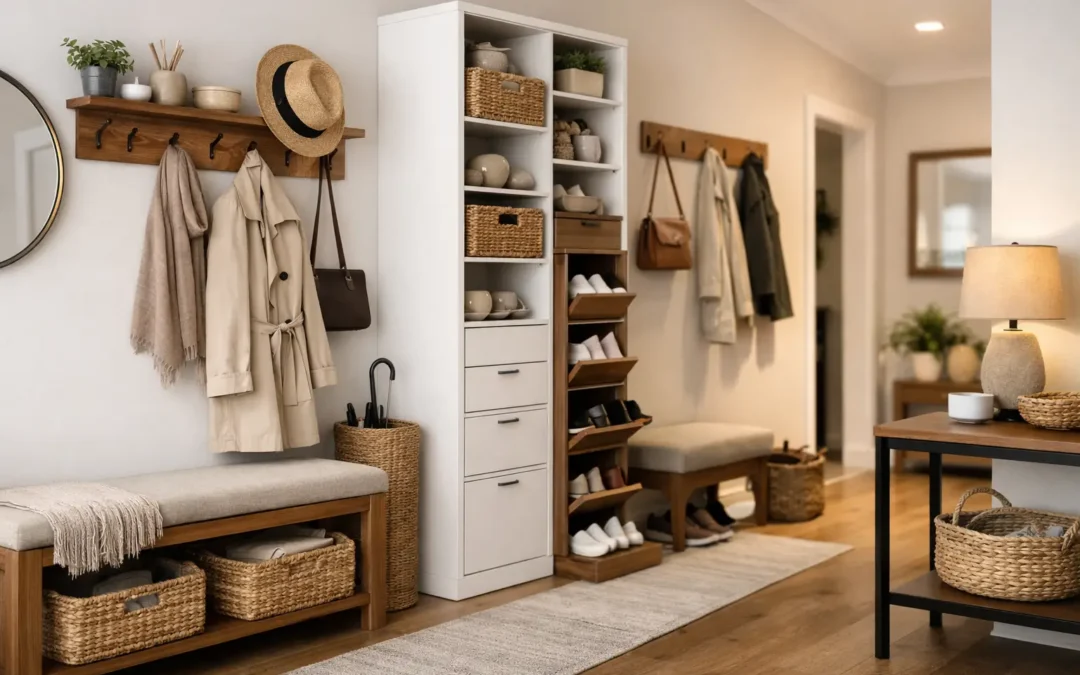
A hallway usually becomes the dumping ground before anyone notices there is a problem. Shoes pile up by the door, coats end up on the bannister, post lands wherever there is space, and suddenly the first part of the home feels cramped. The best storage solutions for hallways fix that pressure point properly, not by squeezing in more furniture, but by making the space work harder without feeling crowded.
Hallways are awkward by nature. They are often narrow, busy and full of practical demands. You need to move through them easily, but they also have to cope with coats, bags, footwear, keys, umbrellas and all the everyday items that need to be close at hand. That balance is what matters most. Good hallway storage should make life simpler from the moment you walk in.
What makes the best storage solutions for hallways work?
The right solution depends on the size of the hallway, the shape of the walls and how the household actually uses the space. A family with school bags, sports kit and several pairs of daily shoes will need a different setup from a couple looking for a cleaner, more minimal entrance.
The biggest mistake is choosing storage based only on what looks tidy in a showroom. In a hallway, depth matters, door clearance matters, and so does traffic flow. If a unit is too deep, it narrows the passage. If hooks are placed badly, coats spill into the walkway. If shoe storage is too small, clutter just gathers around it instead.
The best results come from being realistic. Count the shoes. Think about winter coats versus summer jackets. Decide whether you need somewhere to sit, somewhere to hide clutter, or both. Hallway storage should be designed around daily habits, not wishful thinking.
Slim fitted cabinetry gives the cleanest result
If you want a hallway to feel calm and well organised, fitted storage is usually the strongest option. It can be designed to follow the exact width and height of the available wall, which means you gain usable storage without wasting space around the edges.
This is especially useful in older homes where alcoves, uneven walls or awkward corners make freestanding furniture look like an afterthought. A fitted cupboard can be built shallower than standard retail units, which is often the difference between a hallway that flows and one that feels obstructed.
Closed cabinetry also earns its place in a hallway because it hides visual noise. Shoes, dog leads, shopping bags and cleaning items all have a home, but the space still looks composed. That matters more than people think. Hallways are usually the first impression of the house, and clutter at the entrance can make the whole property feel less settled.
There is a trade-off, of course. Fully bespoke fitted storage is an investment compared with buying a small console or shoe rack. But where space is tight and every centimetre counts, made-to-measure joinery tends to deliver far better long-term value because it solves the problem properly.
Bench seating with storage underneath
A storage bench is one of the most practical additions to a hallway, particularly for family homes. It gives you somewhere to sit while putting shoes on, and the base can be used for baskets, pull-out drawers or lift-up storage.
This works well in wider hallways or entrance areas where there is enough room to stop and use the space, rather than simply pass through it. In narrow corridors, bench seating needs careful planning. Even a useful feature can become frustrating if it makes the route feel pinched.
When designed properly, a bench can do several jobs at once. It anchors the hallway visually, helps keep shoes off the floor and creates a more considered entrance rather than a row of mismatched items pushed against the wall. Add wall hooks or overhead cupboards above it and it becomes a complete storage zone.
Shoe storage needs more planning than most people expect
Shoes are often the main source of hallway clutter, and they are also one of the hardest things to store neatly. Open racks are easy to access, but they rarely look tidy for long. Closed cupboards are neater, but they need enough ventilation and enough capacity for real life.
That is why purpose-built shoe storage tends to outperform generic furniture. The internal layout can be designed around the footwear you actually own, whether that means everyday trainers, school shoes, boots or wellies. Adjustable shelves are useful, but so is accepting that one small cabinet may not be enough.
If the hallway is very narrow, tilt-out units can help because they keep the profile slim. If there is more width to play with, deeper cupboards with shelves or pull-out trays are more flexible. Households with children often benefit from creating easy access at lower level, so the storage is not only neat but also realistic for daily use.
Wall hooks, rails and panels still have a place
Not everything belongs behind a door. Some hallway items need to be grabbed quickly, and that is where hooks and rails still make sense. The key is to use them in a controlled way rather than covering every available wall.
A well-planned run of hooks can be very effective for coats, bags and scarves, especially when paired with panelling or a fitted backboard. This gives the area structure and protects the wall from scuffs and marks. It also looks more finished than a few random hooks fitted at different heights.
The downside is obvious. Open hanging storage can look messy very quickly, particularly in busy households. That does not mean it should be avoided. It just means there should be enough of it, and it should be part of a wider storage plan. A few daily coats on hooks works well. Ten coats, umbrellas and rucksacks all on display usually does not.
Using height is often the smartest move
In small hallways, floor space is limited, so the best answer is often to build upwards. Full-height storage makes use of the wall without increasing the footprint too much, and higher cupboards are ideal for items you do not need every day.
This is where bespoke design really shows its value. A tall fitted unit can include low-level shoe storage, a mid-section for coats and bags, and overhead cupboards for seasonal items. Instead of separate pieces trying to do different jobs, the whole elevation works together.
Ceiling-height storage can also make a hallway look more intentional and less pieced together. Rather than stopping short and collecting dust on top, the cabinetry becomes part of the room. It feels architectural, which is often exactly what lifts a practical area into something smarter and more refined.
The best hallway storage should suit the house
A hallway does not need to be purely functional. It should feel in keeping with the rest of the home. That means materials, colours and finishes matter, especially in period properties or more design-led interiors.
Painted cabinetry can soften the look of fitted storage and help it sit naturally within the space. Timber detailing brings warmth. Panelled fronts can tie in with traditional homes, while cleaner slab styles suit more contemporary interiors. The best storage solutions for hallways are not just efficient. They should also look like they belong there.
This is another reason off-the-shelf furniture can feel limiting. Standard pieces are built for average spaces and broad tastes. Hallways are rarely average. They often need tailored dimensions and a finish that complements the surrounding joinery, flooring and staircase.
When bespoke storage is the better choice
Not every hallway needs a full fitted scheme. If the space is generous and straightforward, a well-chosen bench and a practical shoe cupboard may be enough. But if you are dealing with narrow access, awkward angles, limited depth or a constant battle with clutter, bespoke storage is usually the better route.
A custom solution gives you control over the details that matter most. That includes internal layout, exact depth, door style, paint colour and how each section is used. It also means the storage is designed around your home rather than forced into it.
For homeowners making longer-term improvements, this often makes more sense than trying a series of smaller fixes that never quite solve the issue. A hallway is used every day, often several times a day. When it functions properly, the effect is felt across the whole house.
At WOW Interior Design, that is exactly how we approach fitted storage – practical first, visually strong and built to suit the space properly. The goal is not to fill a hallway with furniture. It is to create order, improve flow and give the entrance the same level of thought as the rest of the home.
Before choosing anything, stand in the hallway at your busiest time of day and pay attention to what gets left out, what causes congestion and what you wish you had to hand. The right storage answer is usually hidden in that everyday routine.