

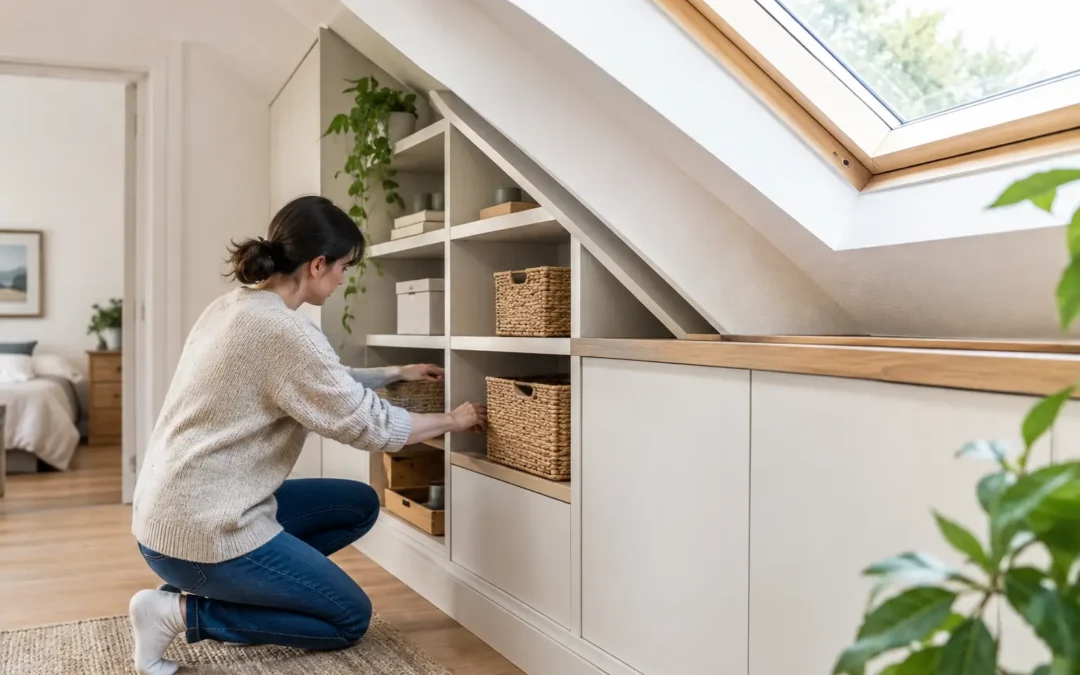
The space beneath a sloping roof is often where good storage plans go to waste. A freestanding chest looks too tall, a standard wardrobe leaves a dusty triangular gap, and the room still feels short of space. This eaves storage guide shows how fitted furniture can turn that awkward area into storage that looks considered, works hard and belongs in the room.
For many homes, particularly loft conversions and top-floor bedrooms, eaves are not a minor detail. They can run the full length of a wall. Designed properly, they can hold clothing, bedding, books, toys, paperwork or household essentials while keeping the room calm and uncluttered.
Eaves storage guide: begin with the roofline
Eaves storage works best when it follows the room rather than fighting it. The pitch of the roof, the lowest usable height, the position of the loft hatch and the location of radiators, sockets and windows all affect what can be built.
This is why measuring is more involved than noting the length of one wall. Ceiling slopes are not always identical from one end of the room to the other, particularly in older properties. Skirting boards may be uneven, chimney breasts can interrupt a run of cabinetry, and low sections may be impractical for doors that need room to open. A precise in-home survey creates the difference between furniture that merely fills a gap and a fitted solution that feels built into the house.
The first decision is not usually colour or handles. It is deciding what the storage needs to do. Deep, low cupboards are excellent for suitcases, spare duvets and seasonal items. Shallower units with shelves suit books, children’s belongings and folded clothes. If the eaves are high enough, a full-height wardrobe at the tallest point can flow naturally into lower cupboards as the roofline drops.
Choose storage around what you use
A beautifully fitted eaves unit will only stay organised if the internal layout reflects everyday life. Think about the items that currently cause clutter, then allow enough depth, height and access to store them properly.
In a main bedroom, low-level cupboards can take bulky bedding and out-of-season clothing, leaving the wardrobe clear for the clothes worn every week. In a child’s room, divided cupboards make it easier to separate toys, games and school supplies. In a home office, eaves storage can conceal files, printers and technical equipment that would otherwise take over the desk area.
Access matters as much as capacity. A very deep cupboard can look generous on a drawing, but items can disappear at the back if there is no practical way to reach them. Shelving, pull-out internal trays or clearly divided sections can make the full depth useful. For infrequently used items, deeper storage is often ideal. For daily-use belongings, a shallower cabinet or drawer arrangement may be the better choice.
Doors, drawers and openings: what suits low ceilings?
There is no single best door style for every eaves run. The right option depends on the available height, how close furniture sits in front of the units and what will be stored inside.
Hinged doors are a popular choice because they give a wide, clear view of the cupboard interior. They work particularly well on medium-height and taller sections, and can be made to follow the slope precisely. However, they need clear floor space to open. In a narrow bedroom, this needs to be planned carefully so doors do not clash with the bed or restrict movement.
Sliding doors can be useful where there is limited room in front of the cabinetry. They create a neat, contemporary face to a long run of storage, although only part of the interior is accessible at any one time. They tend to suit taller eaves areas rather than the lowest sections.
Drawers are practical for folded clothing, shoes, craft supplies and children’s items, especially where the roofline is too low for conventional cupboards. They need sufficient cabinet depth and good-quality runners, but they make excellent use of areas that would otherwise be overlooked. A combination of drawers, doors and open shelving often produces the most useful result.
Make the furniture feel part of the room
The best eaves storage does not announce itself as an awkward-space solution. It gives the room a cleaner shape and a more balanced appearance.
A painted finish can match existing woodwork, blend with the wall colour or provide a deliberate contrast. For a calm bedroom, cabinetry in the same tone as the walls can make a long eaves run visually recede. In a playroom or study, a contrasting painted finish can add character while still keeping clutter behind closed doors.
Handle choice changes the feel too. Slim bar handles suit a crisp modern scheme, while knobs or more traditional pulls can complement period details. Handleless designs keep the lines especially clean, but they need to be specified with a practical opening method. The finish should look good, but it also needs to suit how the household lives. A family bedroom may benefit from an easy-clean painted surface and discreet, durable handles rather than delicate detailing.
Where the eaves storage runs beneath a window, it can also become a feature rather than just cabinetry. A fitted window seat with cupboards below creates a useful place to sit, read or put on shoes. Add a made-to-measure cushion and the room gains both storage and a purposeful focal point.
Do not overlook ventilation and building details
Eaves can hide essential parts of the property, including pipes, wiring, roof ventilation and access points. These must be considered before any furniture is designed. Storage should never block ventilation paths or prevent sensible access for future maintenance.
A bespoke design can include removable panels, discreet access doors or planned voids where needed. This is especially relevant in loft conversions, where insulation and roof construction need to perform properly. A professional survey identifies these practical constraints early, rather than leaving surprises for the fitting day.
Radiators require care as well. Boxing them into closed cabinetry without suitable ventilation can affect heat circulation and may damage the furniture over time. If a radiator sits along the eaves wall, the design may need a ventilated cover, a revised layout or a different use for that section.
Why fitted storage is worth considering
Off-the-shelf units can be useful for a temporary fix, but they are rarely designed for the changing angles and uneven dimensions found beneath eaves. Gaps above, beside and behind the furniture collect dust while reducing the amount of storage gained. Trying to bridge those gaps with filler panels can still leave the room looking pieced together.
Bespoke fitted furniture is made around the exact roofline, wall length and features of the space. That gives you control over internal storage, door sizes, finishes and the relationship between the eaves units and the rest of the room. It can also make a compact loft bedroom feel larger because every element has a clear place.
The investment makes most sense when the room is used every day or when the storage needs to solve a persistent problem. If the eaves only need to hold a few boxes in a seldom-used spare room, a simpler solution may be enough. But where a bedroom, office or family room is short on storage, fitted cabinetry can transform how the space functions.
A straightforward route from idea to installation
A good project starts with a conversation about the room, not a catalogue of standard unit sizes. During a design visit, it helps to show the items you want to store and explain what frustrates you about the current layout. This gives the designer a clear brief and prevents attractive but impractical decisions.
From there, the room can be measured accurately and the cabinetry planned around the roof slope, access requirements and your preferred style. You should be able to see how doors will open, where shelves will sit and how the finished storage will work alongside the bed, desk or seating. A clear quotation and professional installation then keep the process controlled from first idea to finished room.
At WOW Interior Design, we create fully bespoke eaves storage with the same care given to fitted wardrobes, home offices and complete bedroom schemes. The aim is simple: make difficult space work beautifully, without compromising the character of your home.
The unused space under your roof may be one of the most valuable areas in the room. Treat it as part of the design, and it can become the storage that finally gives everything else a place.