

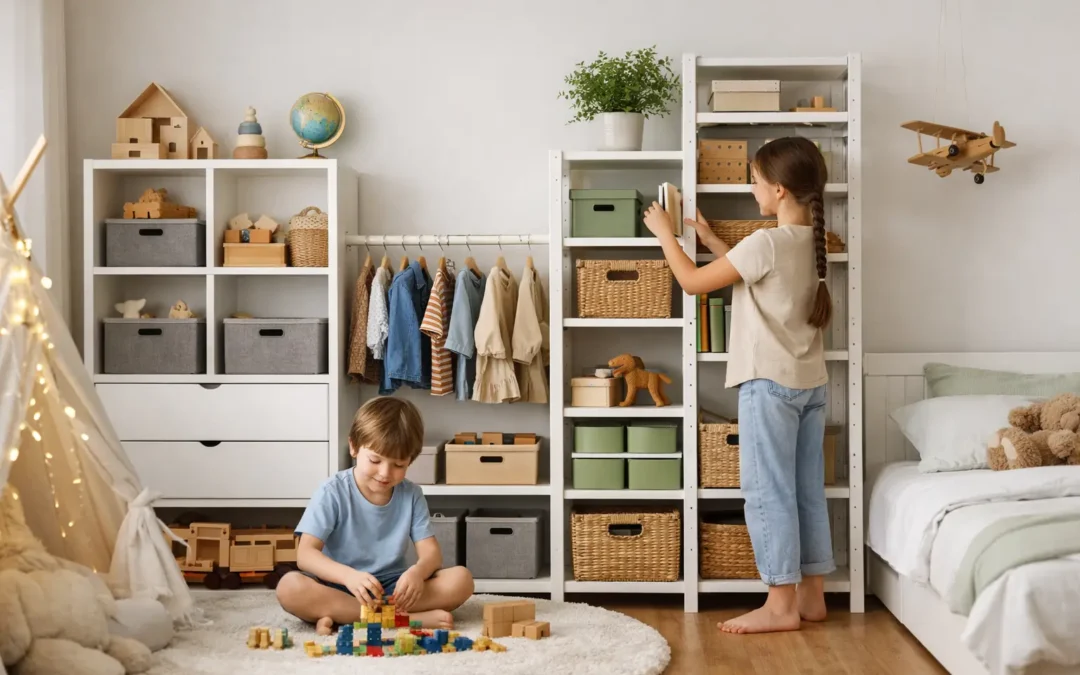
A child’s room can change faster than any other room in the house. One year it is crowded with soft toys, books and building blocks; a few years later it needs space for school uniform, sports kit, homework and a growing wardrobe. Well-planned children’s bedroom storage gives the room a clear place for everything without filling it with mismatched freestanding furniture.
The best answer is rarely more storage for the sake of it. It is storage designed around how your child uses the room now, while allowing for the stage that comes next. A fitted scheme can turn an awkward alcove, sloping ceiling or unused wall into organised, good-looking storage that feels part of the room rather than an afterthought.
Start with what needs to be stored
Before choosing doors, colours or handles, look closely at the contents of the room. Children tend to own a surprising mix of bulky, small and frequently changing items. Clothes need hanging space and drawers. Toys are easiest to manage in open or easy-access compartments. Books need a home that makes reading inviting, while school bags and everyday essentials should be simple to reach on busy mornings.
It also helps to separate items by frequency of use. Everyday clothes, pyjamas and favourite toys belong at child height. Seasonal clothing, spare bedding, keepsakes and outgrown items can sit in higher cupboards. This simple zoning makes a bedroom easier for children to keep tidy independently, rather than relying on an adult to reach everything or make every decision.
A bespoke design begins with these practical questions. How much hanging is genuinely needed? Are drawers better for folded clothes? Does the child share a room? Is there space for a desk now, or will there need to be one in two years? The answers shape a layout that works harder than a standard wardrobe ever could.
Why fitted children’s bedroom storage works
Off-the-shelf units can be useful in the short term, but they often leave wasted gaps above, beside and behind the furniture. In smaller bedrooms, these gaps matter. A fitted wardrobe built to the ceiling uses vertical space for the items that do not need daily access, while giving the room a cleaner, more settled appearance.
Fitted furniture is particularly valuable where the room has difficult proportions. Chimney breasts, alcoves, boxed-in pipework, uneven walls and eaves are common in family homes, especially in older properties across Kent. Rather than treating these features as problems, a tailored design can work around them precisely.
There is also a visual advantage. A coordinated run of wardrobes, drawers, shelving and a desk can make a compact room feel calmer because there are fewer separate pieces competing for attention. Painted cabinetry can be matched to the room’s colour scheme, or finished in a neutral tone that will still suit the room as your child grows up.
Build in flexibility, not a themed room
Children’s tastes can be wonderfully specific and remarkably short-lived. A room based entirely around one character, sport or colour may delight them now, but it can feel dated very quickly. The more practical approach is to keep the main fitted furniture timeless, then bring personality in through paint, bedding, artwork, knobs and accessories that can be changed without replacing the storage.
Inside the furniture, flexibility matters just as much. Adjustable shelves can move as toy boxes become book collections. A combination of hanging rails and drawers can be altered as clothes change in size and style. Cupboards above a wardrobe can store the things parents want to keep but do not need to see every day.
For younger children, lower shelving or cubbies encourage them to put toys away themselves. For older children, a tall wardrobe with a full-length hanging section, deeper drawers and space for shoes may be more useful. There is no single perfect internal layout. The right one depends on the child’s age, habits and the size of the room.
A place for homework and creative work
When floor space is limited, a built-in desk can be more efficient than adding a separate table. It can be designed between wardrobes, beneath shelving or into an alcove, with drawers for stationery and shelves for books. The key is to allow enough worktop depth and legroom, rather than forcing a desk into a space that is too narrow to be comfortable.
A desk does not need to dominate a young child’s room before it is needed. In some cases, shelving and drawer storage can be planned so a desk surface can be added later. Thinking ahead at the design stage avoids having to reorganise an entire bedroom when schoolwork becomes a daily routine.
Use every wall, but protect open floor space
A storage-heavy bedroom should not feel crowded. The aim is to free up the floor for playing, relaxing and moving around, not to put cupboards on every possible surface. Tall storage on one main wall is often more effective than shallow furniture dotted around the room.
The space around the bed deserves careful thought. A fitted headboard wall with shelving can replace bedside furniture, while drawers beneath a bed can be useful for spare bedding or occasional items. However, under-bed drawers are not always the best home for everyday toys, particularly for younger children who may find them difficult to open or forget what is inside.
Wall-mounted shelves are helpful for books and display pieces, but avoid placing heavy or regularly used items too high. Open shelving looks attractive when it is styled lightly; if it becomes a holding area for every toy and school worksheet, it can quickly make the room look untidy. Closed cupboards provide the visual calm, while a smaller amount of open storage gives the room character.
Make organisation easy to maintain
The most impressive storage design will not stay organised if it asks too much of the people using it. Children need clear, simple systems. Deep drawers are useful for larger toys and clothing, but internal dividers stop smaller items becoming a jumble. Shelves should suit the height of books or boxes being stored rather than being spaced at random.
Consider what happens at the end of an ordinary day. Can a child put laundry in a basket, place books back on a shelf and return toys to a cupboard without help? Can they find their uniform and PE kit in the morning? If the answer is yes, the room will feel more manageable for the whole family.
Labels and baskets can help, particularly for younger children, but they work best as part of a considered layout rather than as a fix for inadequate storage. Give each category a defined home first. Then use simple organisers to keep that space functioning.
Choose finishes that can handle family life
A child’s bedroom needs durable surfaces, but practical does not have to mean plain. Smooth painted finishes are easy to wipe clean and can be made in virtually any colour, making them ideal for a tailored scheme. Handles should be comfortable for smaller hands and solid enough for everyday use. Soft-close hinges and drawers are a worthwhile detail, reducing trapped fingers and the repeated banging that comes with busy family life.
Mirror doors can make a small room feel brighter, but they may not suit every age or every layout. Likewise, open shelving creates an appealing display area but requires more regular tidying than closed cabinetry. Good design is about making choices that suit your household, rather than following a showroom look that may not work in practice.
At WOW Interior Design, each fitted bedroom is measured and designed around the room itself, from the awkward corner to the available ceiling height. That allows the storage, finish and internal layout to be tailored to your family rather than adapted from a standard unit.
Plan for the next stage without overbuilding
It is sensible to think ahead, but there is no need to design a nursery as if it must immediately function as a teenager’s room. Focus on the fixed elements that will last: well-proportioned wardrobes, adaptable shelving, useful drawers and a finish with staying power. The internal arrangement and soft furnishings can change as needs evolve.
A free design visit is the right time to discuss those future plans alongside the room’s immediate problems. Bring a realistic view of what needs storing, how the room is used and what you would like to improve. With the right fitted children’s bedroom storage, tidying becomes simpler, the room gains space to breathe, and your child has a bedroom that feels properly theirs at every stage.