

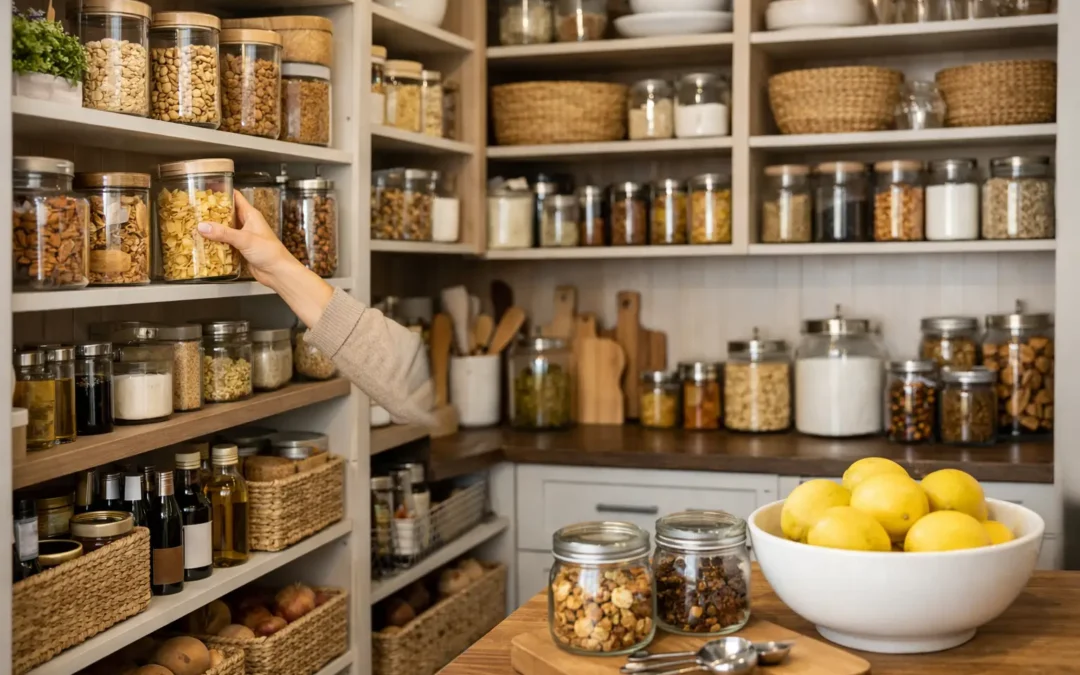
A pantry can look beautifully fitted and still become the kitchen’s least useful cupboard if every packet, jar and appliance is competing for the same shelf. Knowing how to organise a fitted pantry starts with designing around the way your household actually cooks, shops and stores food – not simply decanting everything into matching containers.
A well-planned fitted pantry should make weekday meals quicker, reduce forgotten food at the back of a cupboard and keep worktops clear. The best arrangement is not necessarily the most styled one. It is the one that gives every item a sensible place, remains easy to maintain and makes full use of the space available.
Start by clearing the pantry completely
Before assigning shelves or buying organisers, take everything out. This is the only reliable way to see how much you own, where duplicates have built up and which foods regularly go out of date. Check use-by and best-before dates, dispose of anything unsuitable to keep, and set aside unopened items that your household is unlikely to use.
Wipe down the interior while it is empty, including the corners, door edges and shelf undersides. In a fitted pantry, this is also a useful moment to assess the layout itself. Are tall cereal boxes forced onto their sides? Do tins disappear behind larger packets? Is the lowest cupboard filled with items that are awkward to lift out? These frustrations point to changes worth making.
Group what remains into broad categories before it goes back in. Most homes need areas for everyday dry goods, baking ingredients, tins and jars, breakfast foods, snacks, and larger back-up supplies. You may also need a dedicated place for pet food, packed-lunch items, entertaining supplies or small appliances.
How to organise a fitted pantry in practical zones
The most effective pantry layouts work in zones. Rather than arranging food by what happens to fit, place it according to how often it is used and where it is needed during cooking.
Keep everyday ingredients between waist and eye level. Pasta, rice, cereals, tea, coffee, cooking oils and regularly used sauces belong here because they can be seen and reached without bending or stretching. This central area is the pantry’s prime space, so reserve it for the items that genuinely earn their place.
Use higher shelves for lighter, less frequently used stock. Serving platters, spare paper goods, seasonal baking supplies and bulk purchases are all suitable choices. Avoid storing heavy glass jars or large appliances overhead, especially if the pantry is used by several members of the household.
Lower shelves are ideal for weightier items such as bottles, tins, potatoes, drinks and larger containers. If the pantry is deep, pull-out drawers or internal baskets make this area considerably more practical. They bring contents forward, so you do not need to kneel down and empty half the shelf to find one ingredient.
Keep the zones close to the task they support where possible. A baking area works well with flour, sugars, flavourings, cake cases and scales together. Breakfast is easier when cereals, porridge, spreads and lunchbox snacks are grouped in one accessible section. This small amount of planning prevents the repeated back-and-forth that makes a kitchen feel harder to use than it should.
Match shelf heights to what you store
Fixed shelf spacing is often the reason a pantry becomes untidy. A tall shelf filled with short jars wastes valuable vertical space, while a shallow shelf makes it difficult to store packets upright. Bespoke fitted pantry storage gives you the opportunity to set shelf heights around your own shopping habits.
Measure the taller items first: cereal boxes, bottles, countertop appliances, large flour containers and storage canisters. Then create a mixture of shelf heights rather than making every opening identical. Shorter shelves suit tins, spices and jars, while taller sections are better for bottles, boxes and bulky packages.
Adjustable shelves offer useful flexibility, particularly for households whose needs change over time. However, adjustable is not always the complete answer. Deep cupboards can still hide smaller items, and too many narrow shelves may make the interior look busy. A tailored combination of open shelves, drawers and pull-outs usually gives a neater long-term result.
Make deep storage work harder
A deep fitted pantry provides excellent capacity, but only if the rear of each shelf remains accessible. Put reserve stock behind everyday items, following a simple first in, first out approach. When you buy a new packet of pasta or tin of tomatoes, place it behind the existing one rather than in front.
For small jars, packets and sachets, shallow drawers, pull-out trays or clear handled baskets are more useful than an open deep shelf. You can see the contents at a glance and remove the whole category when cooking. If open shelving is preferred for its appearance, use trays to contain loose items so they do not gradually spread across the cupboard.
Choose containers selectively, not excessively
Decanting can make a pantry look orderly, but it should improve function too. Airtight containers are particularly worthwhile for flour, rice, pasta, cereals, nuts and baking ingredients. They protect food, make quantities easier to see and prevent partly opened packets from creating clutter.
There is no need to decant every product. Tinned goods, jars, sauces and individually wrapped snacks are often easier to keep in their original packaging. Over-decanting creates extra washing up and can remove useful cooking instructions, allergen information and dates. If you transfer food to containers, label each one clearly and include the best-before date.
Choose square or rectangular containers where possible, as they use shelf space more efficiently than round ones. Keep a little room around containers rather than packing every surface tightly. A pantry needs breathing space to stay usable after a weekly shop.
Give small items firm boundaries
Loose packets are the usual source of pantry clutter. Stock cubes, spice sachets, gravy granules, snack bars and baking decorations quickly become difficult to find without some form of containment. A labelled basket or drawer divider gives these smaller products a clear home.
Labels should be practical rather than purely decorative. Use category labels such as Baking, Snacks or Pasta and Rice where several different products live together. For children, a lower snack drawer can encourage independence, but avoid placing sweets within easy reach if that does not suit your household routine.
Build in room for the weekly shop
A fitted pantry should not be filled to capacity. Leaving around 15 to 20 per cent of the storage free gives you somewhere to put new groceries without disrupting every shelf. It also makes it easier to spot what is running low before you shop.
This matters particularly for families who buy in bulk. Bulk buying can save time and reduce the number of shopping trips, but only when there is a controlled back-up zone. Keep reserves together rather than scattering duplicate packets across the pantry. A dedicated lower shelf or deeper pull-out is usually enough.
If you regularly entertain or have a large household, consider a separate zone for drinks, serving items or party supplies. This prevents occasional-use items from taking over the everyday food storage area.
When a fitted pantry layout needs changing
Sometimes organisation alone cannot solve a layout problem. If doors block access, shelves are too deep, the available height is wasted or appliances have nowhere suitable to go, the pantry may need a more considered internal design.
Bespoke fitted storage can incorporate adjustable shelving, full-extension drawers, internal pull-outs, bottle storage and dedicated appliance sections in proportions that suit your kitchen. It is particularly valuable in older homes, where walls, alcoves and ceiling heights are rarely straightforward. A made-to-measure design can use awkward space without making the room feel crowded.
At WOW Interior Design, we plan fitted interiors around the details that make day-to-day life easier, from the height of a shelf to the place you need for a food processor. The aim is not to create storage that only looks good on installation day, but a pantry that remains calm and useful long afterwards.
A properly organised fitted pantry should make dinner preparation feel more straightforward, not give you another cupboard to manage. Give it a sensible structure, allow for real-life shopping habits and leave enough space for the household to change. That is when fitted storage begins to earn its place in your home.