

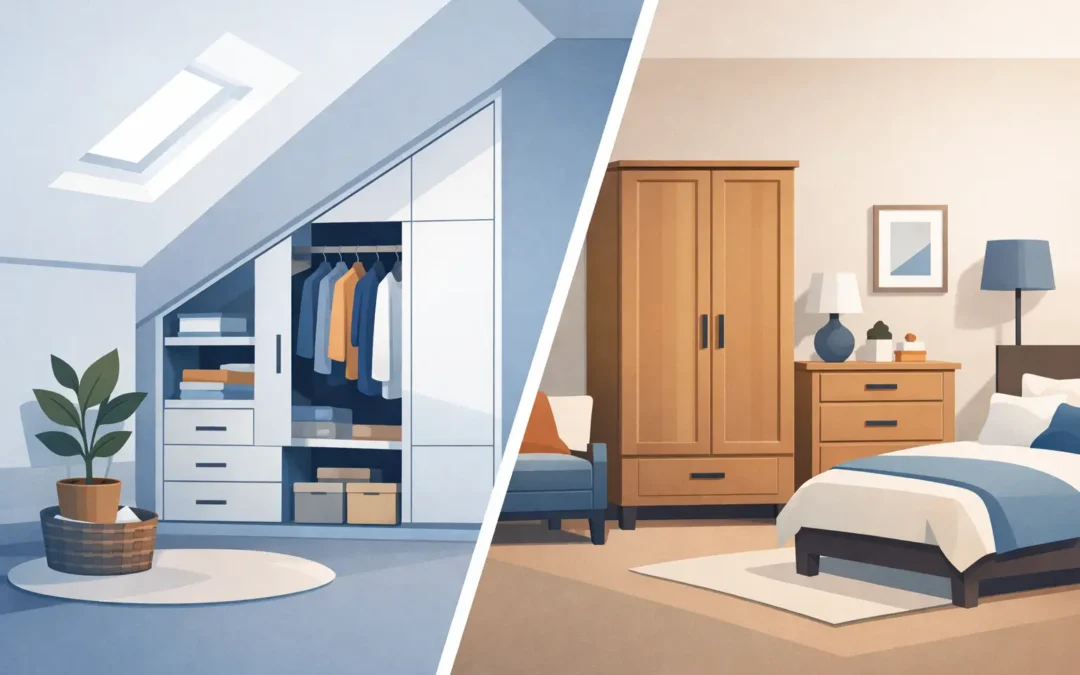
The dead space under a sloping ceiling has a habit of wasting a perfectly good room. You can try to fill it with standard furniture, but that usually leaves awkward gaps, poor access and a bedroom that never feels quite finished. When weighing up sloped ceiling wardrobes vs freestanding furniture, the right answer comes down to how you want the room to work day after day, not just how quickly you can furnish it.
In loft conversions, top-floor bedrooms and period homes with angled ceilings, every centimetre matters. A good storage decision should make the room easier to use, easier to keep tidy and better to look at. That is why this comparison is less about trend and more about practicality.
Sloped ceiling wardrobes vs freestanding furniture: what changes in real life?
On paper, both options store clothes. In practice, they behave very differently.
Freestanding furniture is quicker to buy and easy to move around. If you are furnishing a temporary room or you expect to redecorate often, that flexibility can be useful. The downside is that standard wardrobes are built to standard proportions, and sloping ceilings are not. That mismatch often leaves unusable voids above, beside or behind the furniture.
A fitted wardrobe built into the slope is designed around the shape of the room itself. Instead of working around awkward angles, it turns them into usable storage. Hanging rails, shelving, drawers and cupboards can be planned around what you actually need to store, whether that is long dresses, folded knitwear, shoes or spare bedding. The result is usually calmer, cleaner and far more efficient.
That does not mean fitted is always the automatic choice. If budget is the deciding factor in the short term, freestanding can seem more straightforward. But in awkward rooms, the cheaper option at the start can leave you paying for compromise every single day.
Where freestanding furniture works well
There are situations where freestanding furniture is perfectly sensible. In a box room with straight walls, a guest room used occasionally or a home where you may move soon, buying a well-made wardrobe or chest can be the practical route.
Freestanding pieces also suit people who enjoy changing layouts. You can swap items between rooms, repaint walls without planning around fixed joinery and replace one piece at a time. If your storage needs are modest and the room shape is forgiving, this can be enough.
The problem comes when homeowners expect freestanding furniture to solve a shaped room. Under a sloped ceiling, wardrobes are often too tall at the wrong point and too short where height is available. Low chests may fit physically but fail to deliver enough capacity. You can end up with several mismatched pieces trying to do the job of one properly designed run of storage.
Visually, that often creates clutter. Dust gathers in hard-to-reach gaps, and the room can feel chopped up rather than settled. In a main bedroom, that tends to matter more than people expect.
Why fitted wardrobes suit sloping ceilings so well
A sloped ceiling is not a design problem when the furniture is made for it. It is simply a set of measurements.
This is where bespoke fitted wardrobes earn their keep. They follow the pitch of the ceiling, make use of the full width of the wall and remove those dead spaces that standard furniture leaves behind. Even low or awkward sections can be turned into useful storage with drawers, shoe compartments, pull-out rails or cupboards for less frequently used items.
There is also a strong visual benefit. Because everything is built in, the room feels more architectural and intentional. The furniture looks like it belongs there, rather than being squeezed in afterwards. For homeowners investing in a long-term upgrade, that difference is significant.
A well-designed fitted wardrobe can also improve how spacious the room feels. That may sound backwards, because fitted furniture is permanent, but it is often true. Once storage sits flush to the wall line and works with the slope rather than against it, the room reads as more orderly and open.
Storage capacity is rarely a close contest
If maximum storage is your priority, sloped ceiling wardrobes usually come out ahead.
Freestanding furniture loses capacity in two ways. First, there is the wasted space around it. Secondly, the inside of a standard wardrobe may not match what you need. You may have too much hanging space and not enough shelving, or drawers that are too shallow to be useful. Buying extra pieces to compensate takes up even more room.
With fitted furniture, the internal layout is part of the design. Long hanging on one side, double hanging on the other, deep drawers below, shelving above – it can all be arranged to suit the way you live. This matters especially in family homes, where storage is under pressure and every room needs to work harder.
For loft bedrooms, the difference can be dramatic. Areas that seem too low for furniture can often accommodate low-level cupboards or drawers, while the taller part of the slope can take full-height hanging. Good design makes the whole wall productive.
Cost, value and the question homeowners really ask
The honest question is not whether freestanding furniture costs less. It usually does at the point of purchase. The better question is whether it gives you the result you want.
If you need a quick fix, freestanding furniture has a place. You can walk into a showroom, choose a piece and have the room functioning quickly. But if the room is awkward and you already know standard sizes will not fit neatly, lower upfront cost can mean lower day-to-day value.
Bespoke wardrobes are an investment. They cost more because they are measured properly, designed for the room, manufactured to order and professionally installed. In return, you get storage that fits exactly, looks smarter and tends to add to the appeal of the home rather than feeling temporary.
For many homeowners, that long-term value is what matters. You are not just buying storage. You are improving the room itself.
Style matters, but so does finish
In the debate around sloped ceiling wardrobes vs freestanding furniture, style often gets oversimplified. People assume fitted means formal and freestanding means characterful. That is not really the case.
Freestanding furniture can absolutely bring charm, contrast and individuality, especially in older properties. A painted chest or vintage wardrobe can soften a room beautifully. But in awkward spaces, style alone does not solve practical issues.
Fitted wardrobes now offer far more flexibility in finish than many people realise. Door styles, handles, interior layouts and painted colours can all be tailored to suit the property. Done properly, fitted storage can feel classic, contemporary or somewhere in between. The key is that it should look deliberate and proportionate to the room.
That is often the difference between a room that feels complete and one that still feels like a compromise.
When a mixed approach makes sense
It does not always have to be one or the other.
Some of the best bedrooms use fitted wardrobes under the slope for the heavy-lifting storage, then add one or two freestanding pieces for character. A bedside table, dressing table or accent chest can sit comfortably alongside bespoke fitted furniture without competing with it.
This approach works particularly well if you want the efficiency of made-to-measure storage but still like the softness and personality that loose furniture can bring. The fitted element handles the awkward architecture. The freestanding pieces add warmth.
That balance often gives homeowners the best of both worlds.
How to choose the right option for your room
Start with the room, not the catalogue. Measure the ceiling height carefully across the full wall. Think about what you actually need to store and where the pain points are now. Is the issue lack of hanging space, too few drawers, clutter on show, or furniture that never quite fits?
Then be honest about how long you want the solution to last. If this is your main bedroom and you plan to stay, bespoke fitted furniture is usually the stronger answer. If the room is temporary or the property is likely to change soon, freestanding may be enough.
It also helps to think beyond storage numbers. Ask yourself whether you want the room to feel finished. In sloped-ceiling spaces, that is often where fitted wardrobes pull ahead. They do not just store more. They make the architecture work harder and look better.
At WOW Interior Design, we see this regularly in homes where standard furniture has never quite solved the problem. Once the storage is designed around the room rather than forced into it, the whole bedroom settles.
The best choice is the one that makes the space easier to live with every day – and in an awkward bedroom, a proper fit usually wins.