

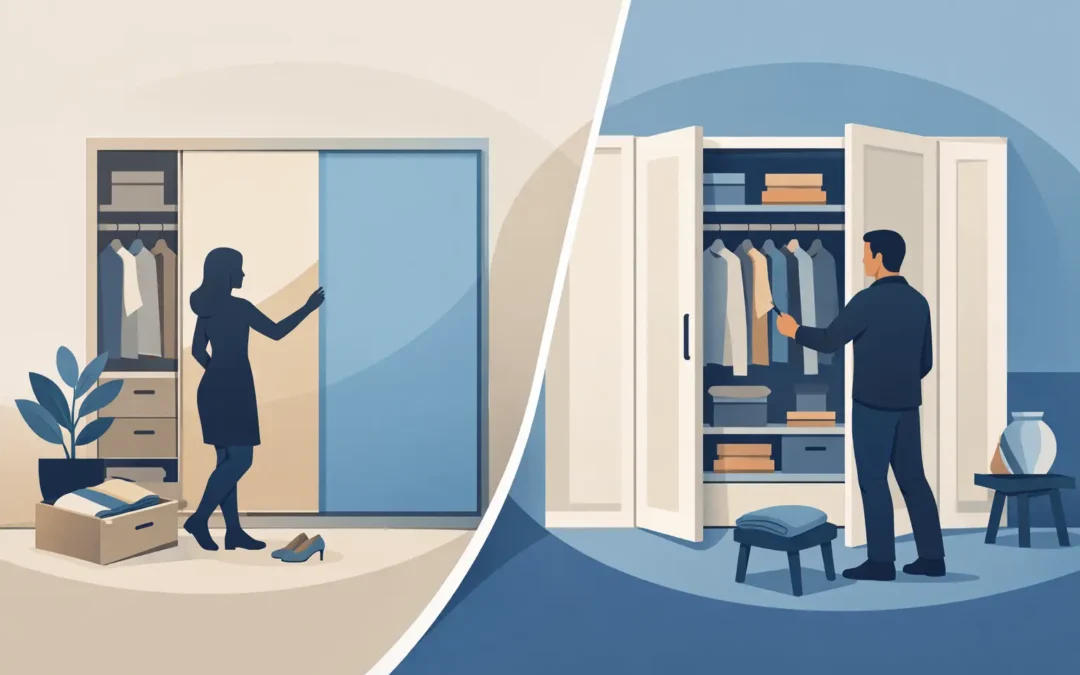
You usually notice the wrong wardrobe door choice after installation, not before. A room can look smart on paper, then feel cramped when doors swing into walkways or frustrating when sliding panels block part of the storage. When clients ask us about sliding doors vs hinged wardrobes, the right answer is rarely about fashion alone. It comes down to how the room works, how you use it every day and what you want the furniture to do.
Sliding doors vs hinged wardrobes – what really changes?
Both options can look excellent in a fitted bedroom. Both can be made to suit the style of the property, from clean modern finishes to something more classic and detailed. The real difference is in how they behave in the room.
Sliding doors move laterally across the front of the wardrobe, so they do not project into the bedroom when opened. Hinged doors open outward, giving you full access to the interior behind each door. That sounds simple, but it affects circulation space, furniture placement, visibility, storage planning and even the feel of the room.
A good fitted design should not ask you to compromise on basic practicality. That is why the door style should be decided alongside the internal layout, room proportions and surrounding furniture, not as an afterthought.
When sliding wardrobes make the most sense
Sliding doors are often the best choice where space in front of the wardrobe is tight. If your bed sits fairly close to the wardrobe run, or the room is long and narrow, a hinged door can become an obstacle. Sliding doors solve that neatly because there is no outward swing to allow for.
They also suit a cleaner, more contemporary look. Large uninterrupted panels can make the room feel calmer and more architectural, particularly in properties where simple lines and a less cluttered finish are the goal. Mirror panels are a popular option too, especially in smaller bedrooms where they help bounce light around and give a greater sense of space.
That said, sliding wardrobes do involve a trade-off. You never see the entire interior at once, because one section will always sit behind another. For some homeowners that is no issue at all. For others, especially those who like to open the wardrobe and view everything immediately, it can be less convenient.
Sliding doors also need careful planning if you want a highly detailed internal arrangement. They work brilliantly with shelves, hanging rails and drawers, but the division of the interior needs to align properly with the door overlap and track system. In bespoke fitted furniture, this is handled at design stage. In off-the-shelf furniture, it is often where the frustrations begin.
Where hinged wardrobes have the advantage
Hinged wardrobes remain a strong choice for good reason. They offer full access to the inside, which is ideal if you want to see everything at a glance or use pull-out internal features more freely. If you have drawers, trays, accessory racks or a carefully planned mix of hanging and shelving, hinged doors make daily use very straightforward.
They are also versatile from a design point of view. Hinged fronts can feel traditional, modern or somewhere in between depending on the style of door, the finish and the handles. If you want painted fitted furniture in a specific colour, panelled fronts or a more furniture-like appearance, hinged doors often lend themselves especially well to that look.
Another benefit is flexibility in room layout, provided there is enough clearance. In a larger bedroom, the swing of the doors is rarely a problem, and the convenience of full opening often outweighs the space-saving benefit of sliders.
The downside is obvious: you need room in front of them. If a bedside table, bed frame or chest sits too close, opening the doors can be awkward. That is not a minor annoyance. It is the sort of daily friction that makes a wardrobe feel less successful than it should.
Space matters, but not in the way people think
Many people assume sliding doors are always the best option for small bedrooms. Sometimes they are, but not automatically.
If the room is compact yet the wall in front of the wardrobe remains relatively clear, hinged doors may still work beautifully and give better access. Equally, a larger room can still benefit from sliding doors if the furniture arrangement creates pinch points. What matters is usable circulation space, not just square footage.
Ceiling height and wall shape matter too. In loft rooms, alcoves and spaces with chimney breasts, a fitted hinged design can sometimes cope better with awkward geometry. In other rooms, a full run of sliding wardrobes can create a cleaner wall-to-wall finish that turns an uneven space into something far more composed.
This is where bespoke design earns its keep. Measuring properly, understanding how the room is used and designing around architectural quirks makes a far bigger difference than choosing a door type based on showroom trends.
Style and finish – which looks better?
Neither, by default. The better-looking option is the one that suits the room.
Sliding wardrobes tend to create a sleek, built-in appearance. They work particularly well in contemporary bedrooms, minimalist schemes and spaces where you want the wardrobe to read as part of the architecture rather than as a stand-alone piece of furniture. Glass, mirror and plain panel finishes are common choices.
Hinged wardrobes can do subtle just as well, but they also allow for more decorative detail. Shaker-style fronts, beading, painted finishes and carefully chosen handles can tie the wardrobe into the rest of the room in a warm, tailored way. In period homes or homes with more character-led interiors, that can be a better fit.
The mistake is treating wardrobe doors as separate from the wider room design. The best results come when the wardrobe works with the wall colour, floor finish, lighting and overall layout. A fitted wardrobe should improve the room as a whole, not just provide storage.
Think about the inside as much as the outside
One of the biggest differences in the sliding doors vs hinged wardrobes decision is how you plan the interior.
With hinged wardrobes, internal access is open and immediate. That makes them well suited to layouts with more compartments, internal drawers and specialist storage. If your wardrobe needs to hold folded clothes, long hanging, short hanging, shoes, bags and smaller items, hinged doors make that arrangement easy to use.
With sliding wardrobes, the internal layout needs to be designed more strategically. You can still include an excellent mix of storage, but it has to be planned around how each section will be accessed. This is not a limitation when handled properly. It simply means the design must be thought through in more detail.
For many households, the smartest approach is to stop asking which door is best in general and start asking what needs to be stored, who will use it and how often. A couple sharing one wardrobe may prioritise visibility and separate access. A guest room may need a simpler arrangement. A main bedroom may benefit from a more design-led front because it shapes the whole feel of the space.
Cost, maintenance and long-term use
Price can vary either way depending on size, materials and finish, so there is no single rule that hinged is cheaper or sliding is more expensive. Bespoke work is always about specification.
Maintenance is worth considering, though. Hinged wardrobes are mechanically straightforward. Sliding wardrobes rely on a track system, which needs to be well made and properly fitted to feel smooth and solid over time. Done correctly, they perform very well. Done badly, they can become the feature everyone regrets.
This is why workmanship matters. Precision measuring, quality components and careful installation are not extras. They are what make a fitted wardrobe feel effortless to use year after year.
Which should you choose?
Choose sliding doors if the room needs clear floor space in front of the wardrobe, if you prefer a streamlined modern look, or if mirrored panels would help the room feel brighter and larger.
Choose hinged wardrobes if you want full access to the entire interior, prefer a more classic or furniture-style appearance, or have the clearance to let the doors open comfortably.
If you are investing in fitted furniture for the long term, the best decision is the one that suits your room and routine rather than the one that appears most often online. A well-designed wardrobe should make daily life easier, keep the room looking ordered and feel right every time you open it. That is the standard worth aiming for.