

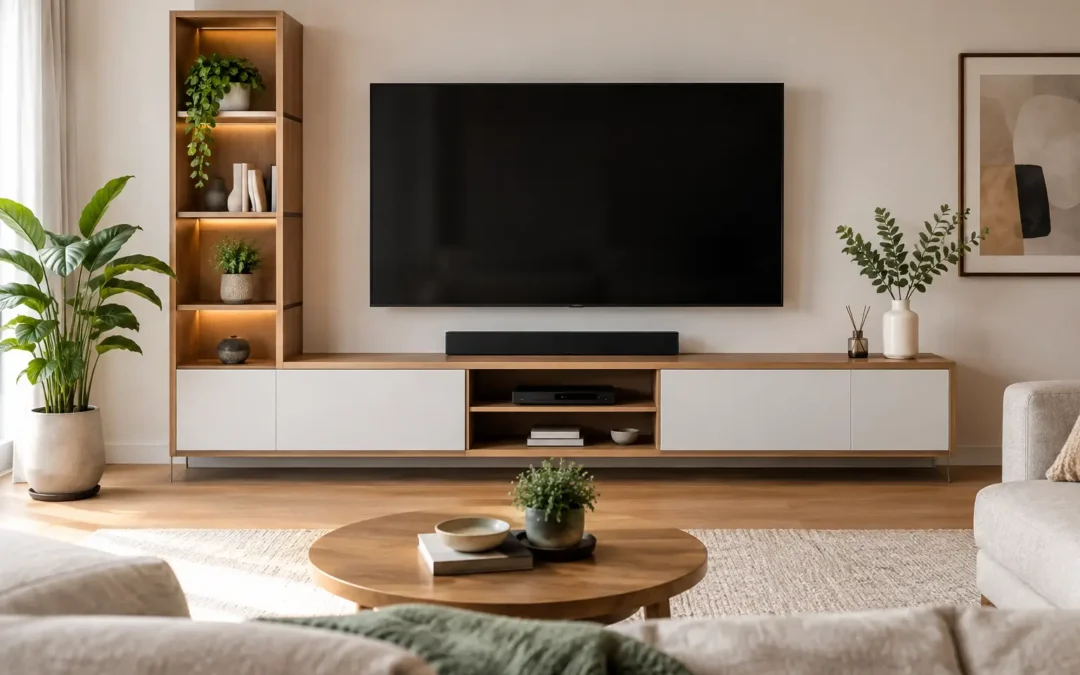
A television wall is often where a living room gathers – and where everyday clutter gathers too. The best media unit features do more than give the TV somewhere to sit. They hide the cables, accommodate the technology, create useful storage and make the whole wall feel considered rather than crowded.
A fitted media unit gives you far more control than a freestanding TV stand. It can be designed around your exact screen size, room proportions and the way your household uses the space. Here are the details worth planning from the start.
The best media unit features to prioritise
1. Proper cable management
Visible leads can spoil even the most beautifully decorated room. A well-designed media unit includes concealed routes for power cables, HDMI leads, aerial connections and internet wiring, keeping everything accessible without leaving a tangle beneath the screen.
The key is to plan for the equipment you own now, as well as what you may add later. Games consoles, soundbars, streaming boxes and routers all need a home. Cable access points behind the TV and within the cabinetry mean connections can be changed without dismantling the unit.
2. Ventilated storage for equipment
AV equipment produces heat, particularly when it is tucked into a cabinet. Enclosed cupboards can look clean, but they need discreet ventilation to avoid trapping warmth around consoles, receivers and other electrical items.
This may be achieved with ventilated backing, carefully placed openings or open shelving where appropriate. The right solution depends on the equipment and how often it is used. A console played every evening needs easier access and more airflow than a streaming box used occasionally.
3. Storage that closes away the clutter
A media wall is rarely just about television equipment. It often becomes the natural place for remote controls, board games, chargers, paperwork, children’s toys and the items that otherwise collect on the coffee table.
A combination of drawers and cupboards keeps these belongings out of sight while remaining close at hand. Deep drawers suit bulkier items, while smaller drawers can be useful for remotes and accessories. Doors are particularly effective for creating a calm, uncluttered finish when the TV is switched off.
4. Open shelves with a clear purpose
Open shelving adds personality, but it works best when it is not treated as spare space. A few well-proportioned shelves can display books, ceramics, framed photographs or a small collection without making the room feel busy.
Consider the balance between display and concealment. Too many open sections can turn a fitted unit into another surface to dust and fill. In family living rooms, a largely closed design with a few carefully positioned display areas is often the most practical choice.
5. A screen position that suits the room
The centre of the television should be positioned for comfortable viewing from the main seating area, not simply centred on the wall. Mounting it too high is a common mistake, especially where a fireplace or a large run of cabinetry dictates the layout.
Screen size, sofa distance and sightlines all matter. A bespoke design allows the TV recess or mounting panel to be set at the right height, while surrounding storage is adjusted to suit. This gives the wall a balanced appearance without sacrificing viewing comfort.
6. Space for a soundbar or integrated audio
Modern televisions may be slim, but their built-in speakers are not always enough for film nights or sports viewing. If a soundbar is part of your plan, give it a dedicated shelf, recess or mounting position rather than trying to fit it in afterwards.
The same applies to speakers. They should not be hidden behind solid doors that affect sound quality. A tailored media unit can incorporate suitable open sections, acoustic fabric panels or carefully considered placement, so the room looks refined and performs properly.
7. Lighting that adds atmosphere, not glare
Integrated lighting can give a media unit real presence in the evening. Warm LED lighting within shelves or around display sections brings depth to the cabinetry and offers a softer alternative to relying on the main ceiling light.
It needs restraint. Bright lighting directly around the TV can create reflections and distract from the screen. Dimmable, warm-toned lighting placed in side shelving or underneath cabinets is usually more effective, particularly in a room used for relaxing.
8. A finish that belongs in the room
A media unit should feel like part of the architecture, not a large piece of furniture pushed against a wall. The finish makes a major difference. Painted doors can match existing joinery or wall panelling, while timber-effect finishes introduce warmth and texture.
Colour is not limited to white, grey or black. Deep blues, warm neutrals, soft greens and rich darker tones can all work beautifully when chosen in relation to the room’s natural light, flooring and furnishings. With bespoke furniture, painted finishes can be specified in the colour that completes the scheme.
9. Proportions that make the wall feel balanced
Tall cabinets, low-level cupboards, floating shelves and a central TV section need to be arranged as one composition. A unit that is too heavy at the bottom can make the wall feel squat, while excessive tall storage may overwhelm a smaller room.
This is where fitted design earns its place. The proportions can be developed around ceiling height, alcoves, chimney breasts, radiators and windows. Awkward gaps are avoided, and every section has a reason for being there rather than filling space for the sake of it.
10. Flexibility for how you will live later
The most useful media units are not designed for one exact moment. Technology changes, children grow up and living rooms often take on new roles. Allowing for adjustable shelves, spare cable routes and adaptable cupboards can extend the useful life of the installation.
You may eventually remove a games console, add a larger TV or want to use part of the unit as a reading or home-working area. A bespoke layout does not need to predict every future change, but it should avoid locking you into an impractical arrangement.
Choosing the right media unit layout
The best layout depends on the wall and the room, rather than following a fixed trend. A long, low run of cabinetry can make a compact room feel wider and lighter. Full-height units either side of the screen offer substantial storage and a more built-in look, particularly where there is a high ceiling or an unused alcove.
A floating unit creates visual space beneath the cabinetry and makes cleaning easier, but it may offer less capacity than floor-standing cupboards. Likewise, a symmetrical design can be pleasing around a centred TV, while an asymmetrical arrangement may be the better answer if a doorway, window or radiator interrupts the wall.
Measure more than the available width. Note socket positions, aerial points, skirting boards, coving, radiator clearance and the route into the room for larger equipment. During a professional design visit, these practical details can be assessed alongside finishes and storage requirements, before the furniture is made.
Why fitted furniture makes a difference
Off-the-shelf media furniture can be useful for a quick change, but standard sizes often leave wasted space at the sides and above the unit. It may also force compromises on cable access, storage depth or TV placement.
A bespoke fitted media unit is designed around the room from the outset. At WOW Interior Design, the process begins with understanding how you use the space, followed by accurate measuring, design development and professional installation. That means the finished wall can work around awkward architecture while delivering the clean, polished look homeowners want.
Choose features that make daily life easier, not simply a wall that photographs well. When cables disappear, storage has a place and the proportions are right, your living room becomes somewhere much more enjoyable to switch off in.