

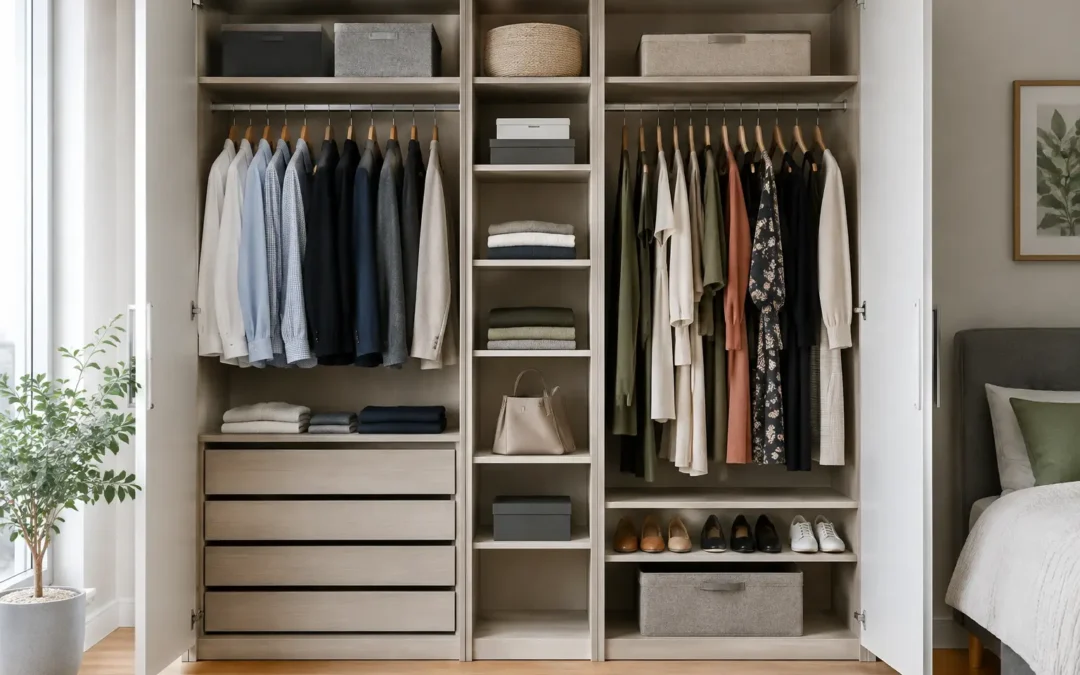
A deep wardrobe can look generous on a floor plan yet become frustrating in daily life. Clothes disappear behind the front rail, folded items turn into unstable piles and the back corners collect things you forgot you owned. Organising deep wardrobes properly is less about buying more storage boxes and more about designing access into every part of the space.
The right layout depends on what you own, how you dress and whether the wardrobe is shared. A household with long dresses, work shirts and children’s bedding needs a very different arrangement from a couple who mainly need hanging space. The aim is simple: every item should have a sensible home that is easy to reach, easy to return to and pleasant to use.
Why deep wardrobes need a different approach
Standard wardrobes are often around 600mm deep, which is enough for hangers while keeping clothing visible from the front. Once a wardrobe becomes deeper, particularly in alcoves or under sloping ceilings, a single front-facing rail wastes the space behind it. Adding extra shelves without a plan can make matters worse, as the rear section becomes inaccessible.
A well-designed deep wardrobe treats depth as an advantage rather than a problem. It creates separate zones for everyday clothing, less frequently used items and bulkier belongings. Instead of asking you to reach around piles or move one rail to access another, it brings storage forward through considered internal fittings.
This is where bespoke fitted furniture earns its place. Off-the-shelf interiors are made to standard dimensions, but the room is rarely standard. A fitted wardrobe can use the full depth, height and width available while allowing for skirting boards, chimney breasts, uneven walls and the way the doors need to open.
Start with what needs to live inside
Before deciding on rails, drawers or shelving, look at the contents honestly. A wardrobe designed around an idealised capsule collection will not work if you own twenty coats, a large shoe collection or several sets of spare bedding.
Separate your belongings into everyday, occasional and seasonal use. Everyday clothing needs to sit at the front and between shoulder and knee height wherever possible. Occasionwear, holiday clothes and items used only a few times a year can sit higher up or further back. Bulky duvets, luggage and storage boxes usually belong in the highest section, where they do not take up prime space.
It also helps to measure longer garments. Full-length dresses, coats and trousers on hangers need more vertical room than shirts and jackets. If everything is placed on one long rail, the lower area is often lost. Splitting the wardrobe into a full-height hanging section and double-hanging sections immediately makes better use of the interior.
Create clear zones from front to back
The most effective way of organising deep wardrobes is to decide what belongs at the front, in the middle and at the rear. The front should be reserved for items used several times a week. This might mean a main hanging rail, shallow drawers for underwear and accessories, and easy-to-reach shelves for knitwear.
The middle and rear are useful for items that are still needed, but not daily. Seasonal clothing can sit behind the main rail if it remains visible and accessible, while spare towels, handbags or folded jumpers can be stored on deep shelves with a practical pull-out solution.
Avoid treating the whole interior as one large open cavity. Deep, fixed shelves are tempting because they are simple to install, but they soon become a stack of items at the front and an unknown collection at the back. Dividing a deep wardrobe into shallower compartments, or using pull-out storage, gives each area a defined purpose.
Use pull-out fittings where access matters
Pull-out rails are particularly useful in deep wardrobes. A front rail can hold your regular clothes, while a second rail behind it can be brought forward when needed. This works well for separating summer and winter wardrobes, or keeping formalwear behind everyday clothing without losing access to it.
Pull-out shelves are another strong option for shoes, handbags and folded garments. Unlike a fixed shelf, they allow you to see the full contents without crouching or removing the items in front. The fittings need to be good quality and properly installed, especially when holding heavier items, but the improvement in everyday usability is substantial.
For shoes, angled pull-out shelves or dedicated shoe drawers can prevent pairs being lost at the back. For accessories, shallow drawers with dividers are often better than shelves. They keep belts, watches, jewellery and sunglasses protected, visible and less likely to create clutter on a dressing table.
Give long items their own home
Long hanging space should be deliberate, not an afterthought. Coats, dresses and longer skirts need a dedicated section with enough clearance below the hem. If they are squeezed into a space designed for shirts, the result is creased clothes and a wardrobe that always looks untidy.
That said, not everyone needs a full-width long-hanging section. In many homes, a narrow full-height bay alongside two shorter double-hanging bays provides a far more efficient balance. The exact proportions should reflect the wardrobe’s owner. This is one of the practical benefits of a design visit: you can plan around real clothes rather than generic assumptions.
Make the high-level space work harder
The upper part of a deep wardrobe is ideal for storage that does not need constant access. A continuous top shelf can hold labelled boxes, spare pillows, holiday luggage or out-of-season items. It keeps these belongings out of sight while using space that would otherwise be empty.
The trade-off is accessibility. Do not put anything heavy or frequently used at the top simply because it fits. High shelving should be deep enough to be useful, but not so deep that a box can be pushed out of reach. A clear labelling system and matching storage containers make this area easier to manage, particularly in a shared bedroom.
In a tall fitted wardrobe, consider whether the top storage should run across every section or be broken up. One long shelf is excellent for large bedding and suitcases. Smaller, separated compartments are better for keeping each person’s seasonal items distinct.
Choose doors that suit the room as well as the storage
Wardrobe doors affect how easy the interior is to use. Hinged doors give a full view of the contents when open, which is helpful where the wardrobe has several zones and drawers. They need clear floor space in front, however, so they may not suit a narrow bedroom.
Sliding doors save room and work well across wide runs of fitted wardrobes, but only part of the interior is visible at one time. They are a sensible choice where circulation is tight, provided the internal layout is planned so that key drawers and hanging sections are not blocked by the door position.
Mirrored doors can make a smaller bedroom feel lighter, while painted doors allow the wardrobe to blend with the room or become a confident design feature. The finish matters, but function comes first. A beautiful wardrobe still needs doors that open comfortably and reveal the storage you use most.
Build in room for changing needs
A wardrobe that works beautifully on installation day should still work years later. Children grow, working patterns change, clothing collections evolve and storage needs can shift from clothes to linens, files or hobby equipment.
A flexible internal design helps. Adjustable shelves are useful in selected areas, while drawers and fixed rails provide reliable structure where it is needed. It is also worth allowing a little spare capacity. Filling every shelf and rail to its limit makes a wardrobe harder to keep organised, regardless of how well it is designed.
For couples, clearly divided sections reduce daily friction. One person may need more hanging space, while the other needs drawers and shoe storage. Equal widths are not always the fairest or most useful solution. Tailoring each side to its owner makes the room easier to live with.
When a bespoke design is the practical answer
Deep wardrobes are often found in the very spaces that make standard furniture difficult: alcoves, loft rooms, older properties and bedrooms with uneven walls or chimney breasts. Trying to adapt freestanding units can leave gaps, wasted height and awkward storage behind the doors.
A bespoke fitted wardrobe can be designed around the exact depth of the room and the way you use it. At WOW Interior Design, the process starts with understanding the space and the contents before creating a layout that combines proper access, considered finishes and a clean fitted result.
The best deep wardrobe does not ask you to reorganise your life around it. It quietly supports your routine, keeps the everyday within reach and gives the less-used items a sensible place to wait.